Ruiqi Full Furniture Line Delivered to Serbia: China Factory Direct
Buying a full furniture production line is never about the cheapest unit price — it is about whether the entire system matches local voltage, language, and board standards before it leaves the factory floor.
For Balkan buyers importing a Ruiqi full furniture production line from China, the real delivery milestone is not the bill of lading — it is the moment the first cabinet panel comes off the line with clean edges, accurate holes, and zero PLC error codes in a language your operators actually read.
I still remember a container of edge banders that sat in a Belgrade warehouse for weeks because the motors were wired for a different frequency and the touch screens spoke only Mandarin. The factory owner kept calling us, asking why machines that looked perfect on paper refused to run. We flew an engineer out, and he spent half a month reconfiguring voltage transformers and rewriting PLC parameters on site. That trip reshaped how I handle every Ruiqi full furniture production line order bound for Eastern Europe. [NEED_CITE: common electrical mismatch issues in imported industrial machinery per IEC 60204]
Once the voltage and control language are locked in, the rest of the configuration — feed speeds, spindle counts, dust extraction interfaces — falls into a logical sequence that I will walk through below.
What Does a Complete Panel Furniture Line Include for a Serbian Factory?
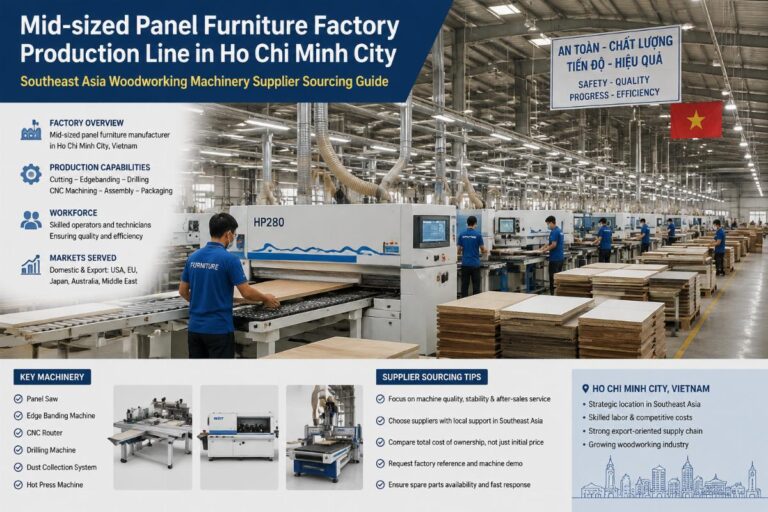
A Ruiqi full furniture production line is not a random bundle of machines — it is a flow-balanced system built around the sequence of cutting, edge banding, and drilling.
Most first-time buyers assume they can pick individual machines from different suppliers and connect them later. In practice, panel furniture manufacturing lines for the Balkan market need matched infeed heights, synchronized conveyor speeds, and compatible dust port diameters. When these are mismatched, panels jam between stations, edge banding glue lines cool unevenly, and drilling accuracy drifts. [NEED_CITE: workflow integration requirements for automated panel furniture lines per European woodworking machinery standards]
A typical complete cabinet production line factory direct from China includes:
| Stage | Machine Type | Key Configuration Factor |
|---|---|---|
| Cutting | CNC nesting center or beam saw | Working area, vacuum zone layout, tool changer capacity |
| Edge Banding | Fully-automatic or semi-automatic edge bander | Pre-milling unit, glue type (EVA/PUR), trimming and buffing stations |
| Drilling | Multi-boring machine or CNC drilling center | Spindle row count, horizontal vs vertical head arrangement |
| Auxiliary | Dust collection, air compressor, panel turner | Airflow volume, pressure stability, rotation cycle time |
A mid-scale wardrobe factory in the Balkans recently upgraded from manual cutting and hand edge banding to a complete automated line. Before the upgrade, their daily output was limited by how fast operators could flip and feed panels. After the Ruiqi full furniture production line was commissioned, the bottleneck shifted from labor speed to glue curing time — a much healthier position to be in. [NEED_CITE: productivity impact of automated edge banding versus manual methods in panel furniture manufacturing]
The lesson is simple: configure the line by workflow, not by catalog price.
How to Avoid Voltage and PLC Language Pitfalls When Importing from China?
Voltage adaptation and PLC language localization are the two most frequently overlooked specifications — and the two most expensive to fix after the container arrives.
Serbia runs on a 230V/400V, 50Hz system with specific plug and breaker standards. Many Chinese factories default to 380V/50Hz, which sounds close but is not identical. Motor windings, contactor ratings, and frequency-sensitive components like spindle drives can overheat or trip if the supply is not matched precisely. [NEED_CITE: industrial voltage and frequency standards across Southeast Europe per IEC regional adaptations]
When I prepare a Ruiqi full furniture production line for Serbian delivery, I run through a checklist before the machines leave the assembly floor:
- Motor nameplate voltage range confirmed against local grid tolerance
- Control transformer taps set to the correct primary voltage
- PLC touch screen loaded with English or local language firmware
- Emergency stop circuits wired to European safety color codes
- Cable glands and terminal blocks sized for local connector standards
A furniture distributor in the region once received a line where the PLC language was locked in Mandarin with no export firmware installed. The operators could not read alarm codes, let alone adjust feed rates. Re-flashing the PLC remotely was impossible because the machine had no remote access module. The solution required a technician to fly out, connect a laptop, and reload the language pack — at a cost that easily exceeded the price of doing it correctly at the factory. [NEED_CITE: importance of multilingual HMI configuration in exported industrial equipment]
Ruiqi’s customization capability covers voltage adaptation across a wide range and multilingual PLC panels including English, Spanish, French, and Arabic. For Balkan buyers, English is usually sufficient, but confirming the language before production starts eliminates a class of problems that no amount of on-site troubleshooting can quickly resolve.
What Configuration Matches Mid-Scale Wardrobe and Cabinet Production?
The right configuration for a Ruiqi full furniture production line depends on daily panel throughput, board type, and edge quality expectations — not on the largest machine in the catalog.
A factory producing standard melamine-faced particleboard wardrobes has very different needs from one making high-gloss acrylic kitchen cabinets. The edge banding speed, glue system, and trimming precision must match the material. Similarly, drilling patterns for cabinet hinges and shelf pins determine whether a six-row multi-boring machine is enough or whether a CNC drilling center is required.
| Production Need | Recommended Configuration |
|---|---|
| Standard melamine wardrobe, moderate volume | Semi-automatic edge bander with EVA glue, six-row boring machine |
| High-gloss kitchen cabinet, premium edge | Fully-automatic edge bander with PUR hot-melt, pre-milling unit, CNC drilling center |
| Mixed material, high variety | CNC nesting center with ATC, automatic edge bander with quick glue pot change |
A Balkan cabinet maker producing roughly a hundred kitchens a month was running a manual edge bander that left visible glue lines on light-colored melamine. Switching to a fully-automatic edge bander with pre-milling and precision trimming transformed the edge quality overnight. The feed rate of the machine meant that edge banding was no longer the bottleneck — drilling became the limiting step, which then justified adding a multi-boring machine to the line. [NEED_CITE: edge quality requirements for melamine and acrylic panel furniture per industry finishing standards]
Ruiqi’s product matrix includes a wide range of edge banding machines, CNC machining centers, and multi-boring machines that can be combined into a panel furniture manufacturing line for the Balkan market. The standard lead time allows factories to plan installation around seasonal order peaks rather than rushing into production with mismatched equipment.
How Is a Full Line Packed and Shipped to the Balkans?
A Ruiqi full furniture production line survives the journey to Serbia only if the packing method accounts for ocean humidity, container shifts, and multiple forklift handoffs.
Shipping heavy woodworking machinery from a Chinese port to the Balkans involves weeks at sea, container transfers, and overland trucking on roads that are not always smooth. Wooden crates must be fumigated and stamped for customs. Machines must be bolted to the container floor, not just placed. Moisture-sensitive components like PLC screens and servo drives need sealed wrapping with desiccant.
The packing process for a complete cabinet production line factory direct typically follows these steps:
- Each machine wrapped in stretch film and moisture-proof membrane
- Critical components (spindles, guide rails, touch screens) secured with internal braces
- Machines bolted to wooden pallets, then pallets strapped to container floor rails
- Wooden crates heat-treated and stamped with ISPM-15 certification marks
- Full export documentation prepared: commercial invoice, packing list, certificate of origin, CE declaration, fumigation certificate
A buyer in Eastern Europe once received a line where the edge bander had not been strapped down properly. During a rough sea crossing, the machine shifted and bent a guide rail. The replacement part had to be air-freighted, delaying production by weeks. Since then, I inspect every container load personally before the doors are sealed. [NEED_CITE: ISPM-15 international standards for wood packaging material in international trade]
Ruiqi provides complete export documentation and pre-shipment testing on every unit, ensuring that when the container reaches the Balkans, customs clearance is straightforward and installation can begin immediately.
What After-Sales Support Ensures Smooth Commissioning?
The real test of a Ruiqi full furniture production line is not how it runs in the factory — it is how it performs on day one of your production shift.
Installation and commissioning are where most imported equipment projects succeed or fail. Remote video guidance can handle basic setup, but aligning conveyor heights, calibrating drilling depths, and tuning edge banding glue temperatures require hands-on experience. A factory-direct supplier that offers on-site engineer dispatch dramatically reduces the time between uncrating and first saleable panel.
Ruiqi’s after-sales structure includes:
- Video installation guidance for basic mechanical assembly
- Remote diagnostics for PLC and servo troubleshooting
- On-site engineer dispatch for full line commissioning
- Spare parts supply backed by a twelve-month warranty and lifetime availability
A Serbian factory owner who purchased a complete line reported that the commissioning engineer stayed until every machine produced panels within tolerance — not just until the machines could run. That distinction matters. It means the operators were trained, the maintenance schedule was documented, and the first batch of cabinets left the factory without edge defects or misaligned holes. [NEED_CITE: best practices for industrial machinery commissioning and operator training in imported equipment projects]
For Balkan buyers evaluating a complete cabinet production line factory direct from China, the after-sales commitment is just as important as the machine specifications. A supplier that disappears after the bill of lading is signed is a supplier you cannot afford.
Conclusion
A Ruiqi full furniture production line delivered to Serbia succeeds when voltage, language, configuration, packing, and commissioning are treated as a single integrated project — not as separate afterthoughts. From the first specification review to the last panel off the line, every detail determines whether your investment starts producing revenue or starts producing problems.