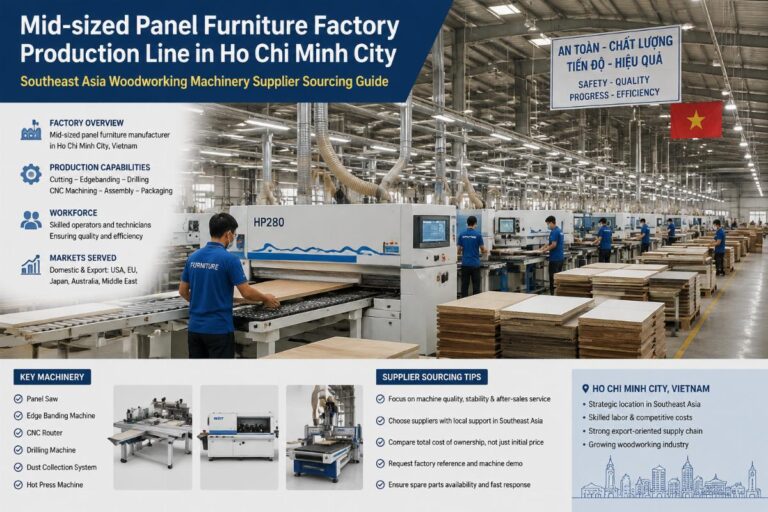
Edge Banding Machine with Container Discount Wholesale Supplier
Most buyers assume container-load discounts mean a flat percentage off the unit price. In reality, the real savings come from freight amortization, production line optimization, and spare parts bundling — not just a lower sticker price.
Purchasing an edge banding machine with container discount through a verified factory-direct supplier typically reduces total landed cost by nearly half compared to single-unit imports, provided specifications are standardized across the load and quality documentation is non-negotiable.
I still remember a shipment that left Qingdao port bound for Lagos — three semi-automatic edge banders loaded into a single twenty-foot container. The buyer, a cabinet workshop owner expanding into modular kitchen production, had negotiated what looked like a solid price per unit. What he did not negotiate was spindle runout tolerance. When the machines arrived and started running melamine-faced particleboard, every panel came off with visible wave patterns along the glued edge. The root cause: pre-milling spindle runout exceeding acceptable thresholds, causing uneven material removal before the glue even touched the edge. That single oversight cost the buyer an entire production batch — mid-six-figure losses in wasted panels, delayed project deliveries, and reputational damage with his own clients. The machines themselves were not returned. The discount he saved on paper was wiped out many times over.
That is why any serious buyer evaluating an edge banding machine with container discount must look beyond the quotation sheet and understand what actually drives the pricing tiers, how to calculate true landed savings, and which quality checkpoints separate a profitable bulk order from an expensive lesson.
The following sections break down the mechanics of container-load purchasing for edge banding machinery, drawing on real procurement scenarios across emerging markets and established distribution networks.
What Determines Edge Banding Machine with Container Discount Tiers?
Discount tiers are not based solely on quantity — they depend on model concentration, shared component architecture, and whether the buyer commits to a framework agreement rather than a one-off purchase.
A common misconception among first-time importers is that ordering more units automatically unlocks deeper discounts. The reality is more nuanced. Manufacturers structure their pricing around production line efficiency. When a container is filled with the same model series — sharing the same spindle assemblies, glue pot configurations, and PLC control modules — the factory can batch-produce core components in a single production run, reducing setup time and material waste significantly. [NEED_CITE: manufacturing cost reduction through component commonality in batch production]
Consider three typical scenarios:
A Nigerian cabinet factory ordering a mixed load of two semi-automatic and two fully automatic edge banders from different product series. Because the machines require different spindle housings, glue pot sizes, and control boards, the manufacturer cannot consolidate production runs. The discount offered is modest — essentially a volume rebate on top of standard pricing.
A Southeast Asian distributor placing an order for a full container of the same fully automatic straight-line edge banding model, with customized voltage for regional grids and multilingual PLC interfaces. Since every unit shares identical core components, the factory schedules a continuous production batch. The per-unit cost drops noticeably, and the distributor also negotiates silk-printed branding on the machine housings at no additional tooling cost.
A Middle East trading company signing an annual framework agreement with quarterly shipment schedules. The total annual volume is committed upfront, allowing the manufacturer to reserve production capacity and raw material inventory. In return, the buyer receives tiered pricing that improves with each quarterly release, plus a spare parts package calibrated to a defined redundancy ratio of wear components.
| Procurement Pattern | Component Commonality | Discount Depth | OEM Customization Availability |
|---|---|---|---|
| Mixed models, one-off order | Low | Basic | None |
| Same series, full container | High | Noticeably reduced unit cost | Full batch-level |
| Framework agreement, phased delivery | High + capacity reserved | Substantially extended savings | Full with priority scheduling |
The takeaway is clear: to maximize the edge banding machine with container discount, buyers should standardize on a single product series wherever possible and commit to volume through structured agreements rather than ad hoc orders. [NEED_CITE: procurement volume commitment strategies in industrial machinery sourcing]
How to Calculate True Cost Savings: Unit Price vs Landed Cost?
The real financial advantage of container-load purchasing lies in freight amortization, customs clearance efficiency, and spare parts redundancy — not just the factory gate price.
When a buyer compares a single machine shipped via less-than-container load against multiple machines in a full container, the per-unit freight cost drops dramatically. Ocean freight rates are charged per container, not per machine. Loading three edge banders into a twenty-foot general-purpose container versus shipping one machine in shared LCL space means the freight cost per unit can drop to a fraction of the LCL rate. [NEED_CITE: LCL vs FCL freight cost comparison for industrial machinery]
But freight is only the beginning. A full container allows the buyer to include a comprehensive spare parts package — cutting blades, trimming knives, buffing wheels, glue pot seals, and sensor cables — without paying incremental shipping costs. For a workshop operating in a region where spare parts lead times stretch across weeks, having a defined redundancy of wear components on hand prevents costly production downtime. The cost of a single emergency air-shipped part can exceed the savings from an entire container-load discount.
Customs clearance also favors full-container shipments. A single commercial invoice covering multiple units and spare parts under one Harmonized System code simplifies declaration, reduces the risk of inspection delays, and in some markets qualifies for expedited clearance procedures. Buyers importing into markets with complex import licensing requirements benefit disproportionately from consolidated documentation.
| Cost Component | Single Unit LCL Shipment | Full Container Load |
|---|---|---|
| Per-unit ocean freight | High | Noticeably reduced |
| Spare parts shipping | Separate costly shipment | Bundled at marginal cost |
| Customs documentation | Multiple declarations | Consolidated single entry |
| Downtime risk from parts shortage | Vulnerable | Resistant |
A buyer in East Africa once calculated that the total landed cost of five edge banders shipped in a single container — including spare parts, tooling, and installation accessories — was lower per unit than the landed cost of importing just two machines via LCL, even before factoring in the manufacturer’s volume discount. The freight savings alone offset a significant portion of the equipment cost.
Which Specifications Should You Standardize Across Container Loads?
Standardizing on a single product series — sharing core spindle, glue pot, and control modules — is the single most effective way to unlock the deepest edge banding machine with container discount.
Cross-series mixing within a single container may seem like a practical way to diversify inventory, but it undermines the batch-production efficiencies that drive bulk pricing. When a container holds machines from the same series — for example, multiple units of fully automatic straight-line edge banders with pre-milling, gluing, trimming, and buffing stations — the manufacturer can produce shared sub-assemblies in a single run. The glue pot housing, the spindle motor mounts, the PLC control boards, and the pneumatic valve blocks are all identical across units. This commonality is what enables meaningful cost reduction.
Critical specification parameters to lock down across the entire container include:
-
Spindle runout tolerance — The pre-milling and trimming spindles must meet tight runout standards to prevent wave-pattern defects on panel edges. Any unit in the container with substandard spindle precision will produce defective work, regardless of how many good units accompany it. [NEED_CITE: spindle runout impact on edge banding surface quality]
-
Feed speed configuration — Whether the line is set for entry-level throughput or high-speed production, all units in the container should match the buyer’s target output rate. Mixed feed speeds across units create inconsistency in workshop workflow.
-
Glue pot temperature control precision — Especially critical when processing PUR hot-melt adhesive, where even minor temperature fluctuations affect glue line visibility and bond strength. The entire container should be calibrated to the same thermal control standard.
-
Voltage and frequency — A container destined for a single market must have uniform electrical specifications. Mixing voltages within the same shipment creates installation confusion and potential safety hazards.
| Specification Parameter | Standardized Across Container | Mixed Within Container |
|---|---|---|
| Spindle precision | Consistent edge quality | Uncontrolled defect risk |
| Feed speed | Uniform workflow output | Variable throughput |
| Glue pot thermal control | Reliable bond strength | Vulnerable glue line quality |
| Electrical configuration | Simplified installation | Complicated commissioning |
A distributor in South America learned this the hard way when a mixed-specification container arrived with two machines configured for one voltage and three for another. The rewiring work on-site added weeks of delay and required local electricians unfamiliar with the control architecture. The edge banding machine with container discount he had negotiated was partially erased by the commissioning overhead.
What Quality Verification Documents Protect Bulk Purchases?
A container-load order without comprehensive factory test documentation is a gamble — the cost of a single defective unit in a full container can exceed the savings from the bulk discount.
When purchasing an edge banding machine with container discount, the buyer has less opportunity to inspect each unit individually before shipment. This makes pre-shipment documentation not just a formality, but the primary defense against quality failures. The minimum documentation package should include:
-
Individual unit test reports — Every machine in the container must have its own test certificate covering spindle runout measurement, feed speed calibration, glue pot temperature stability, and safety interlock function. A blanket "batch passed" statement is insufficient. [NEED_CITE: pre-shipment testing protocols for woodworking machinery exports]
-
Spindle precision inspection records — Specific measurement data for each spindle, demonstrating compliance with accepted runout thresholds. This is the single most critical parameter, as spindle defects cause the wave-pattern edge defects that ruin finished panels.
-
CE certification and ISO quality management certificates — Required for customs clearance in many markets and serves as baseline evidence of manufacturing system compliance. [NEED_CITE: CE marking requirements for woodworking machinery exported to regulated markets]
-
Detailed spare parts list with part numbers — Not a generic "accessories included" line item, but a numbered inventory of every wear component, sensor, and consumable included in the shipment. This list becomes the reference for future reorders and warranty claims.
-
Material and construction certifications — Documentation confirming the use of heavy-duty cast iron frames and CNC-machined precision on critical surfaces, which directly affects machine rigidity and long-term accuracy retention.
A buyer in West Africa once received a container of edge banders with only a single test report covering the entire batch. When two units exhibited excessive vibration during commissioning, there was no individual data to determine whether the defect originated at the factory or during transit. The dispute resolution took months, and production was halted on the affected machines throughout.
| Document Type | Purpose | Risk If Missing |
|---|---|---|
| Individual test report | Unit-level performance verification | Undetected factory defects |
| Spindle inspection data | Edge quality assurance | Wave-pattern defects on panels |
| CE / ISO certificates | Regulatory compliance | Customs rejection or delays |
| Numbered spare parts list | Inventory and reorder reference | Production downtime from missing parts |
| Construction material certs | Long-term accuracy retention | Premature frame deformation |
How to Negotiate OEM and Customization Terms for Container Orders?
Container-load volumes give buyers leverage to request OEM customization — voltage adaptation, multilingual control panels, and brand branding — but these must be explicitly defined in the purchase agreement before production begins.
When ordering an edge banding machine with container discount in quantities of a full container or more, buyers are in a position to request customization that would be impractical or cost-prohibitive for single-unit orders. Manufacturers are willing to accommodate these requests because the batch production model absorbs the customization cost across multiple units.
Key OEM elements to negotiate:
-
Voltage and frequency adaptation — Machines configured for the destination market’s electrical grid. A container bound for regions with non-standard voltage requirements must have every unit pre-configured at the factory, not rewired on arrival.
-
Multilingual PLC interfaces — Control panels with operator menus in the local language reduce training time and minimize operating errors on the workshop floor. Manufacturers with in-house software teams can load language packs during production without delaying the build schedule.
-
Brand logo and color customization — Silk-printed branding on machine housings and custom color schemes to match the buyer’s corporate identity. This is particularly valuable for distributors building their own brand presence in regional markets.
-
Extended warranty and spare parts supply commitments — Container-load buyers should negotiate warranty terms and lifetime spare parts availability as part of the commercial agreement, not as an afterthought.
A distributor in the Gulf region regularly orders full containers of edge banders with Arabic-language PLC panels and customized voltage for regional power standards. Because the order volume justifies the software and electrical configuration work, the per-unit customization cost is negligible. The machines arrive ready to install, and the distributor’s brand appears on every unit delivered to end customers.
| OEM Element | Single Unit Order | Container-Load Order |
|---|---|---|
| Voltage customization | Cost-prohibitive or unavailable | Standard inclusion |
| Multilingual PLC | Not feasible | Full batch-level implementation |
| Brand branding | Tooling cost too high | Included at marginal cost |
| Spare parts commitment | Standard warranty only | Negotiable extended terms |
The critical point: all OEM terms must be documented in the purchase contract before production starts. Verbal agreements or post-shipment requests create disputes that delay delivery and erode the value of the edge banding machine with container discount.
Conclusion
Container-load purchasing of edge banding machinery delivers meaningful cost advantages only when buyers standardize specifications, demand comprehensive quality documentation, and negotiate OEM terms upfront — the discount is a tool, not a guarantee. The true savings emerge from freight consolidation, production batch efficiency, and spare parts bundling, not from a simple price reduction on the invoice. Buyers who approach container procurement with the same rigor they apply to machine specification and quality verification will consistently outperform those who chase the lowest unit price without understanding the mechanics behind it.