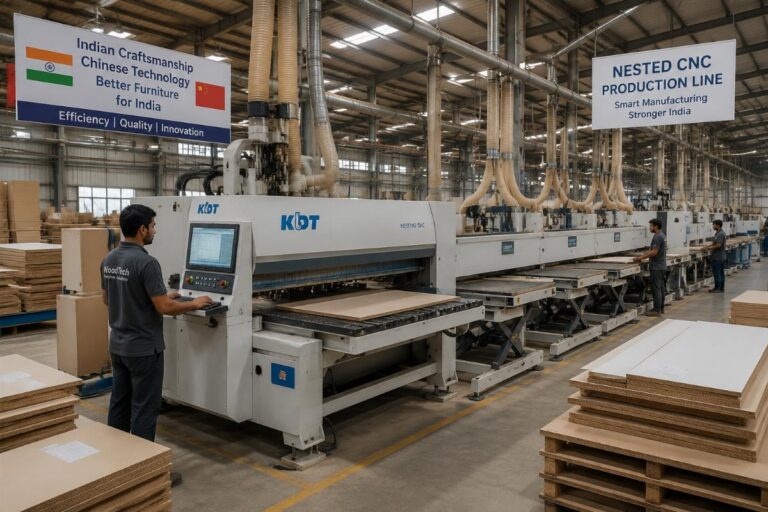
Full Furniture Line Cost in Germany: 2026 Price Guide for Sale
Most buyers think the machine quotation is the total cost. In reality, voltage adaptation, CE compliance retrofitting, and on-site commissioning travel can quietly swallow a quarter of your budget.
A full panel furniture production line sourced from German brands in 2026 typically costs multiple times more than an equivalent-specification line imported from top-tier Chinese manufacturers — and the gap widens further once you factor in six-to-twelve-month European delivery windows versus substantially shorter lead times from Asia. When you break down the full furniture line cost in Germany by production stage, add landing expenses, and compare it against turnkey solutions from certified Chinese manufacturers, the real picture becomes clear.
I learned this the hard way. Years ago, I was handling documentation for a cabinet factory order headed to Monterrey. The edge bander arrived with a PLC panel in English only, while the client expected Spanish. The PUR melting unit was wired for a different voltage tier than what the plant ran. The machine sat idle for weeks while we sorted out adapters, translated manuals, and flew a technician across the Atlantic. That single oversight cost the client dearly in downtime and airfare. Since then, I list voltage, language, and certification line-by-line on every proforma invoice. No exceptions. [NEED_CITE: VDMA machinery export compliance requirements for non-EU voltage standards]
Let me walk you through what actually goes into the full furniture line cost in Germany, stage by stage, hidden cost by hidden cost, so you can build a budget that holds up when the container reaches the port.
What Does a Full Furniture Line Actually Cost in Germany in 2026?
A complete panel furniture production line from established German or Italian brands carries a terminal price that is substantially higher than equivalent-output lines from certified Chinese factories — and the gap is not just about the machines themselves.
When a mid-scale wardrobe manufacturer in Bavaria approached us for a quotation, they already had a bundled quote from a European supplier. The number looked clean on paper. But once we asked them to separate the edge bander, the CNC nesting center, the six-sided boring machine, and the auxiliary conveyors, the picture changed. The European quote bundled "integration fees" and "project management surcharges" that were not itemized. Our breakdown, machine by machine, landed noticeably lower — even after adding ocean freight and customs duties.
Here is what a typical full furniture line cost in Germany looks like when you decompose it by stage:
| Production Stage | Typical Equipment | European Brand Pricing Tier | China-Sourced Tier (Certified Export) |
|---|---|---|---|
| Panel Cutting / Nesting | CNC router or beam saw | Premium | Noticeably lower |
| Edge Banding | Auto straight-line with pre-milling | Premium | Noticeably lower |
| Drilling / Boring | Six-sided CNC or multi-row borer | Premium | Noticeably lower |
| Sanding / Pressing | Wide-belt sander, membrane press | Premium | Noticeably lower |
| Auxiliary / Conveying | Loaders, stackers, turntables | Premium | Noticeably lower |
| Integration / Software | MES linkage, labeling, optimization | Often bundled at high margin | Transparent or optional |
[NEED_CITE: European woodworking machinery market pricing trends from industry association reports]
The key takeaway is not that European machines are bad — they are engineering benchmarks. The key takeaway is that the full furniture line cost in Germany includes layers of overhead that do not show up on a single-line quotation. Brand premium, local labor cost embedded in assembly, extended warranty structures, and software licensing all stack up.
A European cabinet factory owner once told me he received a turnkey quote that included a "commissioning supervision fee" charged per day, with a minimum week guaranteed. When I asked what happened if the machines ran perfectly on day three, the answer was silence. That is the kind of cost structure you need to see before you sign.
How to Break Down Furniture Line Costs by Production Stage?
Pricing by stage — not by package — is the only way to avoid hidden markups buried inside bundled quotations.
Let me take you through each stage and what drives the cost.
Panel Cutting. This is where your raw sheets become sized blanks. The two main options are a nested-based CNC machining center or a computer-controlled beam saw. A CNC router with an automatic tool changer and vacuum table handles both straight cuts and complex contours in one pass. A beam saw excels at high-volume straight-line rip cuts. The price gap between these two categories is significant, and within each category, spindle count, table size, and control system tier determine where you land. [NEED_CITE: CNC router configuration variables affecting panel furniture factory pricing]
Edge Banding. This stage often carries the widest price spread. A basic manual edge bander and a fully automatic through-feed machine with pre-milling, PUR hot-melt gluing, end trimming, flush trimming, scraping, and buffing are not in the same universe of cost. The glue system type — EVA versus PUR — alone creates a substantial tier jump. Add curve-capable functionality and the price climbs again. When I quote a full furniture line cost in Germany-bound projects, I always ask: what board material, what edge finish quality, and what daily panel count? Those three answers determine whether you need a single-spindle manual unit or a twenty-meters-per-minute through-feed auto.
Drilling and Boring. Cabinet production lives and dies by hole accuracy. A twenty-three-spindle multi-boring machine handles standard shelf-pin and hinge patterns. A six-sided CNC drilling center handles everything including dowel holes, connector bores, and hinge cups in a single clamping. The price difference between these two is considerable, and the choice depends entirely on your product mix complexity.
Sanding and Pressing. Wide-belt sanders for surface preparation and membrane presses for foil-wrapped doors are often treated as afterthoughts in line planning. They should not be. A poorly calibrated sander creates rework that eats your margin faster than any machine downtime.
Auxiliary Equipment. Loaders, stackers, turntables, and conveyor bridges are where inexperienced buyers get burned. European quotes often include these at premium markups. Sourcing them separately from specialized auxiliary manufacturers — or including them in a Chinese factory’s turnkey package — can reduce this line item noticeably.
What Hidden Costs Do Buyers Often Miss When Importing Lines to Germany or the EU?
CE certification retrofitting, voltage adaptation, multilingual PLC programming, and post-arrival commissioning travel are the silent budget killers — and they typically add a substantial percentage on top of the machine price.
I cannot stress this enough. I have seen buyers celebrate a low FOB price, only to discover that the machine’s electrical cabinet was not configured for three-phase European voltage standards, or that the safety interlocks did not meet the specific requirements of the EU Machinery Regulation. Fixing these issues on arrival means either flying the manufacturer’s engineers to your site at your expense or hiring local electricians who charge by the hour and do not know the machine’s internal logic.
Here is the hidden cost stack that rarely appears in the initial quotation:
-
CE compliance documentation and physical retrofitting. If the machine was built for a non-EU market, adding CE marking after the fact involves safety guard redesign, emergency stop circuit rewiring, and updated technical file compilation. The cost is not trivial. [NEED_CITE: EU Machinery Regulation compliance cost factors for imported woodworking equipment]
-
Voltage and frequency adaptation. European industrial power runs at specific three-phase configurations. A machine wired for another region’s standard needs transformer adjustments, contactor replacements, and sometimes control board swaps. This is not a plug-and-play situation.
-
PLC language localization. A control panel in English is fine for an English-speaking operator. But if your shop floor runs in German, Spanish, or Polish, you need the HMI translated. Some manufacturers charge per language. Others include it. This should be clarified before purchase.
-
On-site commissioning travel. If the manufacturer does not have a local service partner in your region, you are paying for flights, hotels, per diems, and visa processing for their engineers. A two-week commissioning visit from East Asia to Central Europe is not a small expense.
-
Spare parts reserve. European brands often have long lead times for replacement parts — sometimes stretching into months. Building a critical spares inventory at purchase time avoids costly production halts later.
A distributor in Eastern Europe once bought a second-hand European line to refurbish and resell. The machines were mechanically sound. But the control software was locked to a legacy operating system, the documentation was in a single language, and the original manufacturer had discontinued support. The refurbishment cost ended up exceeding what a comparable new line from a responsive Chinese supplier would have cost — with none of the responsiveness.
China-Sourced vs. Germany-Sourced Lines: When Does Each Make Sense?
If your priority is brand prestige, ultra-fine tolerances on exotic materials, and you have a long capital deployment timeline, a European line makes sense. If your priority is fast ROI, flexible configuration, and a budget that respects cash flow, a certified Chinese manufacturer covers the vast majority of mainstream production scenarios.
This is not a ideological statement. It is a pattern I have observed across dozens of projects.
European lines excel in environments where the product mix is highly specialized, the tolerances are extreme, and the customer base expects the brand name on the machine to signal quality to their own clients. Think high-end bespoke kitchen manufacturers in Munich or Milan, where the machine itself is part of the marketing story.
Chinese lines — from established, export-certified manufacturers — excel in environments where throughput matters, product variety is high, and the capital budget needs to stretch across multiple machines rather than concentrate in one flagship unit. The engineering gap has narrowed dramatically over the past decade. Core structural components like cast iron frames, precision-ground guideways, and CNC-machined mounting surfaces are now produced to tight tolerances in top-tier Chinese facilities. The difference in finished panel quality, for ninety percent of standard cabinet and wardrobe production, is negligible to the end consumer.
| Decision Factor | European-Sourced Line | China-Sourced Certified Line |
|---|---|---|
| Lead time | Extended, often half a year or more | Substantially shorter |
| CE / international certification | Built-in for EU market | Available from certified exporters |
| Voltage and language adaptation | Standard for home region | Customizable per order |
| Price tier | Premium | Noticeably lower |
| After-sales response in non-EU markets | Depends on dealer network | Direct factory remote support plus dispatch |
| Customization flexibility | Often limited to catalog options | High, including OEM branding |
[NEED_CITE: Comparative lead time and certification analysis for woodworking machinery export from China versus Europe]
I worked with a small-scale cabinet shop in Latin America that had been quoting a European line for over a year. The price kept climbing as they added options. They finally came to us, specified their board types, daily panel targets, and edge finish requirements. We configured a line — CNC nesting center, auto edge bander with pre-milling, multi-boring machine, and auxiliary conveyors — at a fraction of the European number. The machines shipped within weeks, not months. The client was running production before their European quote’s validity period expired.
The full furniture line cost in Germany simply does not compete on price-performance for most mid-market producers. It competes on heritage, brand perception, and — in some cases — marginal precision gains that only matter at the very top of the market.
How to Request an Accurate Full-Line Quotation Without Getting Overcharged?
Specify four parameters before you ask for any price: board material type, daily panel output target, automation level, and certification requirements. Without these, any quotation you receive is a guess — and you will pay for the guesswork.
I have reviewed quotations where the buyer asked for "a complete cabinet line" without specifying whether they were processing melamine-faced particleboard, raw MDF, or plywood. These materials behave differently during cutting, edge banding, and drilling. Tooling requirements change. Dust extraction needs change. The machine configuration changes. A quotation that does not ask you these questions is not a serious quotation.
Here is the information you should provide to any supplier before requesting a full furniture line cost in Germany-bound or any international project:
-
Board material and thickness range. Melamine, PVC-wrapped, raw MDF, plywood, or solid wood panels each demand different tooling and feed rate settings.
-
Daily panel output and shift structure. Are you running one eight-hour shift or three? This determines whether you need a basic semi-automatic edge bander or a high-speed through-feed unit.
-
Product mix complexity. Simple shelf-and-side cabinet boxes require different drilling configurations than full kitchen cabinets with drawer boxes, blind corner units, and decorative door panels.
-
Certification and compliance requirements. CE marking for Europe, UL awareness for North America, or local standards elsewhere. This must be stated upfront, not discovered at the port.
-
Factory voltage and control language. Three-phase configuration, frequency, and the language your operators read on the HMI.
-
Automation integration needs. Do you want MES connectivity, barcode-driven routing, or automatic labeling? These are add-ons that carry separate costs.
When you provide this information, a serious manufacturer will return a quotation that is itemized by machine, by option, and by compliance requirement. You will be able to compare line item to line item. You will not be comparing a bundled European package against a bare-bones Asian quote that excludes half the necessary components.
A buyer in Southeast Asia once sent me a competitor’s quotation that listed "complete line" with a single price and no breakdown. I asked them to request an itemized version. The competitor refused. The buyer came back to us. We provided a full breakdown — machine by machine, option by option, freight term by freight term. They placed the order within days.
Conclusion
The full furniture line cost in Germany is not a single number — it is a stack of machine prices, integration fees, compliance costs, and landing expenses that only becomes visible when you decompose it stage by stage. Buyers who request itemized quotations, specify their production parameters upfront, and compare certified Chinese alternatives against European premiums consistently arrive at more realistic budgets and faster production start dates. The machines that carry the highest brand names do not always deliver the highest return on investment.