Discount Furniture Machine Supplier from Shandong Factory
Most buyers assume low price means compromised precision. The real culprit is inadequate stress-relief treatment on castings — not assembly quality.
Shandong factories deliver a substantial cost advantage over European brands through direct manufacturing, but total cost of ownership hinges on verifying frame metallurgy, PLC language adaptation, voltage compatibility, and after-spare supply chains before signing the contract.
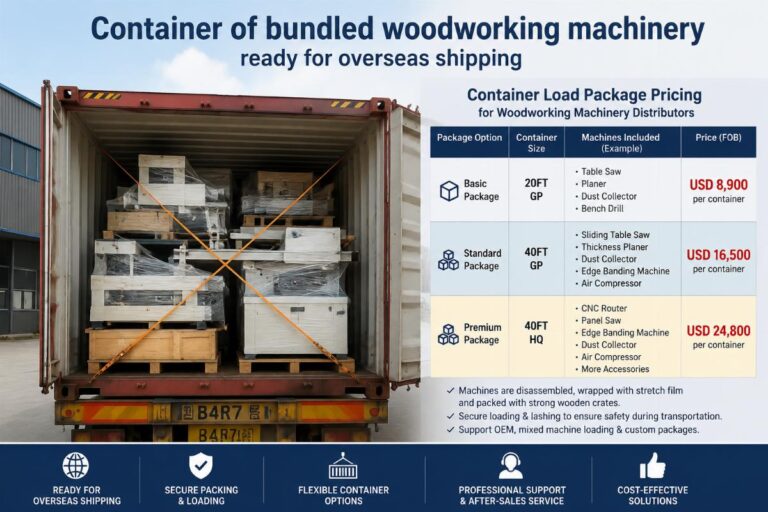
I still remember a full container of automatic edge banders we shipped to a Mexican cabinet workshop. The machines arrived in perfect mechanical condition. Then the on-site team called: the PLC screens were all in Chinese. Two weeks of video calls, timezone headaches, and idle production lines before we could push a Spanish-language firmware update remotely. That order cost us far more in support hours than the margin we saved on manufacturing. Since then, I check language packs, voltage plates, and casting certificates before I even look at the price list. When evaluating a discount furniture machine supplier from Shandong factory, precision specs are only half the equation — the other half is whether the machine actually works in your workshop environment. [NEED_CITE: root cause distribution of import machinery field failures in emerging markets]
Let me walk you through what actually matters when sourcing from this region.
What Machines Are Included in a Complete Panel Furniture Production Line?
A standard panel furniture line consists of four core machines — CNC nesting router, automatic edge bander, multi-boring machine, and panel saw — with auxiliary equipment scaled to daily output volume.
The nesting-based CNC router handles cutting, drilling, and grooving in a single setup, replacing the traditional sliding table saw for batch processing. The automatic edge bander applies PVC, ABS, or melamine edge strips with pre-milling, gluing, end trimming, flush trimming, and buffing stations in one pass. Multi-boring machines drill hinge cups, shelf pins, and system holes in fixed or programmable patterns. Panel saws handle cross-cutting and sizing for remaining components. Auxiliary equipment — vacuum pumps, dust collectors, air compressors, and roller conveyors — bridges the stations.
| Configuration Level | Typical Setup | Suitable Daily Output | Automation Degree |
|---|---|---|---|
| Entry-Level | Semi-auto edge bander + manual CNC router + sliding table saw | Low-volume custom shop | Manual-heavy |
| Mid-Range | Fully automatic edge bander + ATC CNC router + beam saw | Mid-scale batch production | Semi-automated |
| Turnkey Line | Integrated line with auto-loading, PUR edge bander, six-row boring | High-volume factory | Fully automated |
A small cabinet startup in West Africa approached us after years of hand-edge-banding with contact cement. Their daily output barely covered a dozen cabinets. We configured a semi-automatic edge bander paired with a single-spindle CNC router and a basic multi-boring unit. Within one production cycle, their daily panel throughput multiplied several times over, and they cut their edge-banding labor headcount dramatically. The investment payback came far faster than they expected. [NEED_CITE: productivity comparison between manual and semi-automated panel furniture workflows]
The mistake many first-time buyers make is selecting machines by individual catalog price rather than system compatibility. A high-speed edge bander paired with a low-throughput CNC router creates a bottleneck that wastes the investment on both ends.
How Much Can You Save Buying Direct from Shandong Factories vs European Brands?
Factory-direct pricing from Shandong typically runs substantially below comparable European machinery, but shipping, customs, installation support, and spare parts logistics form the real total cost.
European brands command premium pricing built on decades of brand equity, localized service networks, and integrated automation ecosystems. Shandong manufacturers eliminate distributor markups and leverage regional supply chain density — Ningjin County alone concentrates hundreds of woodworking machinery components suppliers within a compact industrial zone. [NEED_CITE: regional industrial cluster cost advantage analysis for woodworking machinery manufacturing in China]
However, the headline price gap narrows once you factor in the full import chain. Ocean freight for a full container of production line equipment runs into four-figure territory. Import duties vary sharply by destination country. Installation support — whether remote video guidance or on-site engineer dispatch — carries real cost. And spare parts availability determines whether a minor breakdown means a same-day fix or a month-long production halt.
| Cost Factor | European Brand | Shandong Factory-Direct |
|---|---|---|
| Machine List Price | Premium tier | Substantially lower |
| Shipping & Customs | Moderate (closer to many markets) | Moderate to high (ocean freight) |
| Installation Support | Included in premium | Separate line item |
| Spare Parts Lead Time | Short (regional warehouses) | Requires advance stocking |
| Voltage Adaptation | Standard for destination | Must be specified at order |
A Middle East distributor once placed a full-container OEM order with private-label branding. The unit prices looked attractive. But because they had not pre-negotiated voltage customization for their local grid standard, the machines arrived requiring external transformers — adding cost and footprint that partially erased the savings. The lesson: always confirm voltage adaptation range at the quotation stage, not after the container seals.
What Specs Should You Verify Before Placing an Order?
Precision tolerance, frame material construction, PLC language options, and voltage compatibility are the four non-negotiable checkpoints that separate a sound investment from an expensive lesson.
Frame construction is the single most misunderstood specification. Many buyers assume precision loss comes from poor assembly. In reality, the root cause is inadequate stress-relief treatment on cast iron frames. Welded steel frames are lighter and cheaper to produce, but they deform over time under vibration and thermal cycling. Properly aged cast iron frames — subjected to natural or artificial aging processes — maintain geometric stability over extended service life. [NEED_CITE: comparison of geometric stability between cast iron and welded steel machine frames under prolonged vibration]
| Specification | What to Verify | Risk if Ignored |
|---|---|---|
| CNC Machining Precision | Core component tolerance class | Drift over time, edge band misalignment |
| Frame Material | Cast iron with stress-relief treatment vs welded steel | Long-term deformation, precision loss |
| PLC Language | Multilingual interface matching operator language | On-site debugging delays, remote support cost |
| Voltage Adaptation | Range covering local grid standard | Equipment damage or need for external transformers |
| Spindle & Motor Rating | Continuous duty rating, not just peak | Overheating in sustained production |
The Mexican case I mentioned earlier is not unique. PLC language mismatch is one of the most common — and most preventable — causes of field support escalation. A multilingual control panel is not a luxury add-on; it is the primary interface between your operators and the machine. When operators cannot read error codes or parameter menus, every minor fault becomes a major production stoppage.
At our production facilities, every control panel ships with the language configuration confirmed at order stage. We offer multilingual interfaces covering major operating languages, and voltage adaptation across a broad range to match destination grid standards without external hardware.
How Do You Match Machine Configuration to Your Production Needs?
Board thickness range, daily panel output target, and workshop power stability determine whether a semi-automatic setup, fully automatic line, or complete turnkey solution is the right fit.
Start with your product mix. If you process standard thickness melamine-faced particleboard for cabinet carcasses, a straight-line automatic edge bander with pre-milling handles the job efficiently. If you regularly switch between thin back panels and thick countertop blanks, you need a machine with adjustable pressure beams and variable feed speed to prevent chipping on thin stock and ensure adequate glue adhesion on thick stock. [NEED_CITE: edge banding quality parameters relative to board thickness and feed speed]
Daily output targets drive the automation tier. A custom cabinet shop producing a few dozen pieces per day can operate efficiently with a semi-automatic edge bander and a basic CNC router. A factory running multiple shifts to produce hundreds of panels daily needs a fully automatic edge bander with dual trim stations, an ATC-equipped CNC machining center, and an automated multi-boring unit — ideally linked by roller conveyors or a return-line system.
Workshop power stability is the silent killer of machinery investments. In many emerging markets, grid voltage fluctuates sharply during peak hours. Machines with sensitive servo drives and frequency inverters require stable input power. If your workshop experiences frequent voltage dips, specify machines with wide voltage tolerance or invest in power conditioning equipment upfront — the cost is minor compared to a burned servo drive.
A small furniture startup in Southeast Asia came to us wanting the fastest edge bander we offered. After reviewing their actual daily volume and product mix, we recommended a mid-range configuration instead. The high-speed model would have run at a fraction of its capacity most days, wasting energy and accelerating wear on consumables. The mid-range machine matched their throughput perfectly and left room for growth.
What After-Sales Support Should You Expect from Chinese Suppliers?
Video installation guidance, remote PLC diagnostics, and on-site engineer dispatch capability form the standard after-sales tier — but warranty duration and spare parts supply chain reliability matter far more than the initial machine price.
The distance between Shandong and most overseas workshops means physical service visits carry logistical cost. Smart suppliers have built layered remote support systems: multilingual video call teams walk operators through installation and calibration; remote PLC access allows engineers to diagnose error codes and push parameter adjustments without flying across continents. For complex issues that cannot be resolved remotely, on-site engineer dispatch remains available.
The critical question is spare parts availability. A machine under warranty means nothing if a replacement sensor takes weeks to clear customs. The best suppliers maintain export-ready spare parts inventories and ship consumable kits — trimming blades, buffing wheels, glue pots, sensor modules — alongside the initial order so workshops have buffer stock from day one.
| Support Element | What to Confirm Before Ordering |
|---|---|
| Warranty Duration | Standard coverage period and what it excludes |
| Spare Parts Supply | Whether consumable kits ship with initial order |
| Remote Diagnostics | Whether PLC remote access is supported |
| On-Site Dispatch | Availability and cost structure for engineer visits |
| Multilingual Support | Whether after-sales team covers your operating language |
We provide a standard warranty period on all machines, lifetime spare parts supply, and a multilingual after-sales team covering video-guided installation, remote diagnostics, and on-site engineer dispatch when needed. Every machine undergoes full pre-shipment testing before leaving our facility, and complete export documentation is prepared to smooth customs clearance at destination.
Conclusion
Sourcing a discount furniture machine supplier from Shandong factory delivers genuine cost advantages, but only when buyers verify frame construction, precision specs, PLC language, and voltage compatibility before ordering. The machines themselves are capable — the risk lies in mismatched configuration and unverified support infrastructure. Define your production parameters clearly, confirm every interface detail at the quotation stage, and treat after-sales spare parts logistics as a first-order selection criterion rather than an afterthought.