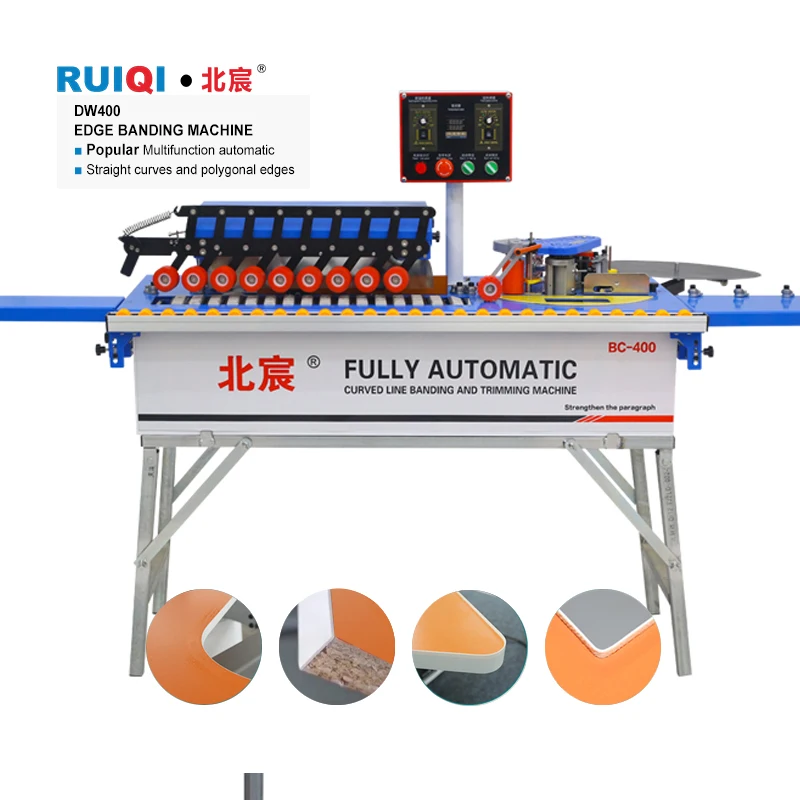
Edge Banding Machine for Wooden Furniture – Distributor Supply
<p><strong>DW400 Automatic Edge Banding Machine, 3800W, 0.3-3mm Banding Thickness</strong> — handles MDF, plywood, particleboard and polymer doors with straight trimming, chamfering and polishing in one pass.</p> <ul> <li>Compact 116×47×69cm footprint fits workshops scaling from manual to semi-automated edge processing</li> <li>Multilingual control panel in Chinese, English, Spanish or French avoids commissioning delays</li> <li>Voltage configurable 220V/380V to match destination market electrical standards</li> </ul> <p>Regional distributors benefit from a unified model family, simplifying regional product mix selection and after-sales parts support. <strong>Four-stage QC with pre-shipment factory test records</strong> verifies edge quality and tolerance before dispatch.</p>
Features
Quality
Certified
Shipping
Worldwide
Support
24/7 Service
Delivery
Fast Lead Time
Verified Tolerance — Patented cutting mechanisms hold ±0.02mm accuracy across the DW400 automatic edge banding machine, verified through four-stage QC before dispatch to distributor warehouses.
Technical Specifications
| Parameter | Value |
|---|---|
| Model | DW400 |
| Product Type | Automatic Edge Banding Machine |
| Total Power | 3800W |
| Voltage | 220V/380V/customization |
| Standard Features | Straight edge banding, trimming, polishing |
| Minimum Sheet Length | 25CM |
| Minimum Sheet Width | 10CM |
| Edge Banding Height | 0-50MM |
| Edge Banding Thickness | 0.3-3MM |
| Trimming Power | 650W*2 |
| Polishing Power | 180W*2 |
| Vacuum Power | 1200W |
| Air Source Pressure | 0.5-0.8Mpa |
| Glue Pot Capacity | 1000ml |
| Overall Dimensions (L×W×H) | 116×47×69CM |
| Net Weight | 70KG |
| Control System | (source value — verify against manufacturer catalog) |
| Feed Speed | (basis not stated in source — confirm feed rate specification) |
| Language Options | Chinese, English, Spanish, French (customizable) |
Application Suitability
| Application | Material or Output |
|---|---|
| Cabinet door edge finishing | MDF and particleboard with PVC or veneer banding |
| Custom furniture panel processing | Plywood and blockboard up to 50MM edge height |
| Polymer door production | Polymer substrates with 0.3-3MM edge material |
| Small batch joinery work | Solid wood panels requiring straight edge trimming and polishing |
Why Voltage Confirmation Must Precede the Purchase Order
A machine built for 380V/50Hz becomes dead weight in a market running 220V/60Hz.
I have watched distributors in South America and Southeast Asia take delivery of edge banders that could not power on because the factory defaulted to a domestic voltage configuration. The cost of replacing motors, rewiring control cabinets, and arranging return freight wipes out any margin the distributor had negotiated. When sourcing an edge banding machine manufacturer for regional resale, confirming local voltage and frequency at the quotation stage prevents machines from arriving as unusable inventory [NEED_CITE: voltage and frequency standards by export market].
Matching Model Tiers to Regional Demand
Distributors need a product family that covers the full spectrum of workshop sizes in their territory. The DW400 sits at the compact end, suited for joinery startups and small cabinet shops operating on limited floor space. Its 116×47×69CM footprint and 70KG weight mean it can ship as a single pallet unit, keeping freight costs manageable for initial stock orders. As a distributor, you can survey the edge banding machine manufacturer range and recommend upgrade paths to your customers without introducing a competing brand into your catalog.
Language Configuration as a Contract Clause
Early in my career, I shipped an automatic edge bander to a distributor in South America without specifying the control panel language. The machine arrived, the installer powered it on, and the operator stared at a screen full of Chinese characters. The distributor called me, furious, slapping the desk on the other end of the line. Commissioning stalled for days until we flew in a bilingual technician. Since then, every contract I handle includes the panel language as a non-negotiable line item. The DW400 supports Chinese, English, Spanish, and French, with additional languages configurable before the unit leaves the factory [NEED_CITE: operator interface language requirements in industrial machinery exports].
How Specifications Translate to Edge Quality
The 0.3-3MM edge banding thickness range covers the materials most furniture workshops use daily: thin PVC for cabinet carcasses, thicker veneer for visible door fronts, and mid-range ABS for worktops. When a distributor stocks a machine that handles this full range, customers do not need to buy separate units for different product lines. The dual trimming motors at 650W each provide sufficient torque to cleanly remove excess material on both top and bottom edges in a single pass. The 1200W vacuum system extracts trimming debris at the source, which matters in enclosed workshops where airborne dust contaminates glue pots and affects bonding consistency. Air source pressure between 0.5-0.8Mpa drives the pneumatic actuators that position the banding strip and engage the trimming cutters; specifying this clearly ensures the buyer installs an adequately sized compressor.
The Hidden Cost of Incompatible Feed Heights
Distributors who sell individual machines without verifying how they integrate with a customer's existing line often face complaint calls months later. A panel enters the edge bander at a specific feed height; if the upstream saw or downstream boring machine operates at a different elevation, operators must manually lift or lower each workpiece. This slows throughput and introduces handling damage. The DW400 accommodates sheet widths down to 10CM and lengths down to 25CM, which suits small offcuts common in custom furniture shops, but the feed height relative to adjacent stations must be confirmed during the line layout phase. I have seen distributors lose repeat business because the machines they sold worked perfectly in isolation but created bottlenecks when placed inline [NEED_CITE: production line integration standards for woodworking machinery].
What Distributors Gain from This Supply Partnership
Every DW400 unit can carry your own branding, with custom logo placement and private-label documentation. The four-stage QC process — incoming material inspection, in-process checks, finished product verification, and pre-shipment testing — means you receive a factory test record specific to the panel thickness and edge material your customer will run. Voltage and plug configurations are confirmed at the order stage, not discovered at the destination port. Spare parts lists ship with every unit, so your local service team can stock consumables without waiting for international freight. The CE declaration and ISO 9001 certificate support import documentation in regulated markets.
Documentation & Verification
- Factory test record run on your specified panel thickness and edge material before dispatch
- Electrical schematic confirming voltage, frequency, and plug type for destination market
- Operation manual translated into the agreed operator language
- CE declaration of conformity for customs clearance in regulated import markets
- Spare parts list with part numbers matched to your regional inventory codes
Installation, Commissioning & Support
- 116×47×69CM footprint requires a level floor with clearance for panel infeed and outfeed on both sides
- 3800W total power draw demands a dedicated circuit matching the confirmed voltage and plug configuration
- 0.5-0.8Mpa air supply must be connected via a filtered regulator to protect pneumatic actuators
- Control panel language verified against operator requirement before the unit is crated for shipment
- Initial glue pot fill uses the 1000ml capacity; recommend stocking compatible adhesive for local ambient temperatures
- Vacuum extraction port sized for the 1200W system connects to workshop dust collection or a standalone extractor
Preparing a Distributor Inquiry
To configure the right model mix for your territory, share the voltage and frequency standards in your market, the panel materials your customers most commonly process, and the control panel languages your service team can support. If you are evaluating a phased rollout, indicate which workshop segments you plan to address first so the product family can be mapped to your regional catalog. Sample processing tests on your actual edge materials can be arranged before committing to a stock order.
Frequently Asked Questions
Q: How do I select the right model tier for different customer segments in my territory? A: Map your customer base by workshop size and production volume. The DW400 suits joinery startups and small cabinet shops with limited floor space. For customers planning to scale, the product family includes higher-tier models with additional workstations. This allows you to offer upgrade paths within one brand, keeping spare parts inventory and training consolidated under a single distributor agreement.
Q: What voltage and plug configurations can be set before shipment? A: The DW400 supports 220V, 380V, and custom configurations. Specify your market's standard voltage, frequency, and plug type at the quotation stage. The factory confirms these parameters on the electrical schematic before production begins, ensuring the machine powers on immediately upon arrival without requiring local electrical modification or motor replacement.
Q: Can the control panel language be customized for my local operators? A: Yes. The standard language options include Chinese, English, Spanish, and French, with additional languages configurable on request. Specify the required language as a contractual line item so it is verified during pre-shipment testing. This prevents commissioning delays caused by operators unable to navigate an unfamiliar interface.
Q: What edge banding materials and thicknesses does this model handle? A: The DW400 processes PVC, ABS, and veneer edge banding from 0.3MM to 3MM thick, with edge heights up to 50MM. This covers the majority of cabinet and furniture applications. If your customers run materials outside this range, higher-tier models in the product family accommodate thicker and wider edge stock.
Q: Is sample processing available before I place a stock order? A: Yes. Send representative panel samples and your preferred edge banding material to the factory. The engineering team will run a processing test, document edge quality and trimming accuracy, and share the results with factory test photographs. This lets you verify output quality against your market's expectations before committing to an initial inventory order.
Request a Quote
Fill in the form below and our team will get back to you within 24 hours.