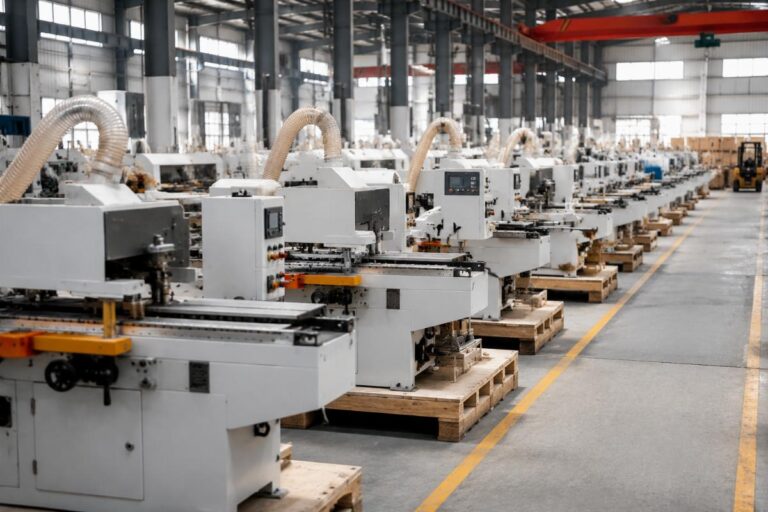
Buy Edge Bander Manufacturer
Most buyers think the core spec of an edge bander is feed speed. In reality, pre-milling precision and glue temperature control determine whether your panels survive a humidity shift or delaminate within months.
When sourcing from an edge bander manufacturer, the real decision is not about the lowest unit price. It is about verifying voltage compatibility, PLC language packages, pre-milling tolerance, and after-parts availability before the machine leaves the factory floor. A mismatch on any of these can idle an entire production line for weeks, and the resulting loss dwarfs the price gap between suppliers.
I still remember a shipment that landed in a Mexican cabinet workshop a few years back. The semi-automatic edge banding line ran perfectly during factory trials in Shandong, but once it reached the customer’s facility, the local voltage tolerance drifted outside the machine’s input range, and the PLC panel had no Spanish interface. The line sat dead for weeks. The customer was furious, the airfreight cost for a replacement control board ate most of the margin, and the whole episode could have been avoided with a thirty-minute checklist before loading. Since then, I treat voltage adaptation, multilingual HMI, and pre-milling parameters as non-negotiable checkpoints, not afterthoughts. [NEED_CITE: common failure modes in imported woodworking machinery related to power supply mismatch]
That single incident reshaped how I evaluate every edge bander manufacturer I work with. Price matters, but it is nowhere near the whole story.
What Specs Should You Compare When Buying an Edge Bander?
Feed speed gets the brochure headline, but pre-milling accuracy, gluing method, and the number of trimming and buffing stations are what actually decide edge quality.
Many first-time buyers fixate on meters-per-minute figures. A machine that runs fast but produces uneven pre-milling will generate visible glue lines, chipped edges on melamine, and poor adhesion that fails peel tests. The pre-milling unit removes a thin layer from the panel edge to ensure a clean, square bonding surface. If that unit lacks rigidity or the cutter head runs with noticeable runout, the rest of the machine’s stations are compensating for a problem that should never have existed. [NEED_CITE: influence of pre-milling quality on edge band adhesion strength per woodworking industry testing standards]
When I compare quotes from different suppliers, I build a matrix around these dimensions rather than speed alone:
| Parameter | Entry-Level Semi-Auto | Mid-Range Automatic | High-End Fully-Auto |
|---|---|---|---|
| Pre-milling unit | Typically absent or basic | Included, dual motor | Precision unit with independent depth control |
| Gluing method | EVA cartridge | EVA tank with digital temp control | EVA and PUR capable, closed-system glue pot |
| Trimming stations | Single top-bottom | Top, bottom, and end trimming | Multi-station with flush, radius, and flat scraping |
| Buffing positions | One | Two | Three with adjustable pressure |
| PLC interface | Single language, basic | Multi-language selectable | Full language suite with remote diagnostics port |
A small workshop in West Africa once ordered an entry-level machine based purely on price. Within months, the EVA glue pot struggled with local humidity swings, and the single trimming station left visible witness marks on white melamine panels. Upgrading to a mid-range unit with digital temperature control and an additional scraping station resolved the issue, but the downtime and rework cost far exceeded the original price difference. [NEED_CITE: effect of ambient humidity on EVA hot-melt adhesive performance in edge banding]
When you evaluate an edge bander manufacturer, ask specifically about the pre-milling spindle bearing grade, the glue pot temperature stability range, and whether the trimming knives are sourced from recognized tooling suppliers or unbranded blanks. These details separate a machine that produces saleable furniture from one that generates constant complaints.
How Do You Verify Voltage and Language Compatibility Before Shipment?
Confirm the exact input voltage range, PLC language package, and motor frequency match before the machine is crated. This is not a paperwork formality; it is the difference between a machine that runs on day one and one that sits idle for weeks.
Different regions use different voltage standards and frequency cycles. A machine wired for one standard and shipped to another will either fail to start, trigger protective shutdowns, or, in the worst cases, burn out motor windings. The problem is compounded when the PLC screen is locked to a single language. An operator who cannot read the error codes is effectively blind, and even simple faults become major downtime events. [NEED_CITE: industrial machinery voltage standard variations across major global markets]
I now run every order through a verification sequence before the machine leaves the production floor:
- Input voltage range is confirmed against the destination country’s grid specification, including acceptable tolerance bands, not just nominal voltage.
- Motor frequency is matched to the local grid, and dual-frequency capability is documented where needed.
- The PLC language package is loaded and tested in the target language, with all menu levels navigated, not just the home screen.
- A full power-on test is recorded on video, showing the machine cycling through all stations with the correct language interface visible.
- The test video and a printed voltage configuration label are sent to the buyer for written sign-off before container loading.
A distributor in the Middle East once received a container of edge banders where the PLC panels defaulted to Chinese only. The local technicians could not navigate the diagnostic menus, and every minor fault required a video call with the factory at inconvenient time differences. The issue was eventually resolved with a firmware update, but the frustration damaged the distributor’s reputation with their end users. [NEED_CITE: importance of localized HMI language in industrial machinery adoption in non-English markets]
When selecting an edge bander manufacturer, insist on written confirmation of voltage and language configuration, backed by video evidence. A factory that hesitates or offers vague assurances is exposing you to unnecessary risk.
What Is the Difference Between Semi-Auto and Fully-Auto Edge Banders for Your Factory?
A semi-automatic edge bander suits low-volume shops; a fully automatic line with pre-milling and PUR capability is the minimum requirement for any operation running规模化 production.
The choice between semi-auto and fully-auto is not about ambition; it is about daily panel volume and edge quality expectations. Semi-automatic machines require manual panel feeding and often lack pre-milling, making them suitable for custom shops producing a limited number of panels per day. Fully automatic machines handle feeding, pre-milling, gluing, trimming, scraping, and buffing in a single pass, and they maintain consistent quality at high throughput. [NEED_CITE: production capacity comparison between semi-automatic and fully-automatic edge banding equipment]
| Factor | Semi-Auto Edge Bander | Fully-Auto Edge Bander |
|---|---|---|
| Daily output capacity | Suitable for low-volume custom work | Designed for continuous high-volume production |
| Pre-milling capability | Usually absent | Standard or optional precision unit |
| Glue system | Basic EVA cartridge | EVA tank or PUR closed-system |
| Operator requirement | Manual feeding, higher labor input | Automated feed, minimal operator intervention |
| Edge quality consistency | Variable, skill-dependent | Highly repeatable, parameter-controlled |
A startup cabinet maker in Southeast Asia initially purchased a semi-automatic machine to keep capital expenditure low. As orders grew, the manual feeding became a bottleneck, and the lack of pre-milling meant inconsistent adhesion on melamine panels. Switching to a fully automatic model with pre-milling and digital glue control eliminated the bottleneck and reduced edge-related customer complaints to near zero. The investment paid back within a reasonable period through labor savings and waste reduction. [NEED_CITE: return on investment factors when upgrading from semi-automatic to automatic edge banding machinery]
When consulting with an edge bander manufacturer, be honest about your daily panel count and your quality tolerance. A machine that is undersized for your volume will cost you more in overtime and rework than a properly sized line ever would.
How to Evaluate a Manufacturer’s OEM Capability and After-Sales Support?
OEM capability is not just about slapping your logo on the cabinet. It extends to voltage adaptation, language customization, packaging, documentation, and, critically, the depth of spare parts inventory and responsiveness of after-sales service.
Many buyers focus on whether a factory can print their brand on the machine. That is the easiest part. The real test is whether the manufacturer can adapt the machine to your market’s technical requirements, provide documentation in your language, and support the machine for its entire service life with accessible spare parts and technical guidance. [NEED_CITE: key components of OEM customization in woodworking machinery manufacturing]
A complete OEM process should cover:
- Control panel branding and language localization.
- Voltage and frequency adaptation with documented configuration.
- Custom packaging with your branding and handling instructions.
- User manuals and maintenance guides translated into the target language.
- A spare parts catalog with clear part numbers and availability timelines.
- Remote diagnostic capability and a defined response protocol for on-site service when needed.
A regional distributor in Latin America once partnered with a factory that offered attractive OEM pricing but had no structured spare parts inventory. When a control board failed, the replacement took weeks to source, and the distributor’s end user was left with an idle machine. Switching to an edge bander manufacturer with a documented spare parts warehouse and a defined warranty and support framework eliminated that vulnerability. [NEED_CITE: importance of spare parts availability and after-sales infrastructure in industrial machinery distribution]
When evaluating an edge bander manufacturer, ask for their spare parts catalog, their warranty terms, and their protocol for remote and on-site technical support. A factory that cannot articulate these clearly is not ready for serious export business.
What Is the Real Total Cost of Ownership Beyond the Machine Price?
The purchase price is only the visible layer. Downtime from voltage mismatches, extended waits for spare parts, and the cost of flying in technicians for commissioning are the hidden expenses that determine the true cost of ownership.
Buyers often compare machines based on the invoice amount. But a machine that sits idle for weeks due to a preventable configuration error, or one that cannot be serviced locally because spare parts are unavailable, costs far more than its purchase price suggests. The true cost of ownership includes commissioning efficiency, production uptime, spare parts accessibility, and the manufacturer’s ability to resolve issues remotely or dispatch support promptly. [NEED_CITE: total cost of ownership factors in capital equipment procurement for manufacturing]
A furniture factory in Eastern Europe purchased a machine at a notably low price from a supplier with limited export experience. The machine arrived without proper documentation, the voltage configuration was incorrect, and the spare parts for a proprietary glue pump were unavailable for an extended period. The resulting production losses and the cost of emergency technical support from the factory far exceeded the initial savings. Switching to an edge bander manufacturer with standardized export configuration, comprehensive documentation, and a structured spare parts supply restored production stability. [NEED_CITE: case studies of hidden costs in imported machinery procurement]
When you evaluate an edge bander manufacturer, look beyond the quotation. Ask about their pre-shipment testing protocol, their documentation package, their spare parts availability, and their after-sales response framework. These factors determine whether your investment performs as expected or becomes a persistent source of cost and frustration.
Conclusion
Buying from an edge bander manufacturer is a technical decision, not just a commercial one. Voltage compatibility, PLC language, pre-milling precision, and after-sales infrastructure are the factors that determine whether your production line runs smoothly or becomes a costly lesson. Verify these details before shipment, and the machine’s true value will become clear on the factory floor, not on the invoice.