Ruiqi Video Installation Guidance Package | Factory Direct Supplier
Most overseas machine installations fail not because of mechanical precision, but because of wiring errors and language barriers on the PLC panel.
A complete video installation guidance package is the single most effective tool for跨境木工设备交付. It replaces paper manuals with localized, step-by-step visual walkthroughs covering electrical pre-checks, PLC language switching, single-machine dry runs, and full-line commissioning — compressing on-site setup from weeks to days.
I still remember the first full cabinet line we shipped to Jakarta. The machines arrived in perfect condition, but when the local team opened the control panels, they found every label in Chinese. Worse, they had wired the three-phase power in the wrong sequence. The entire line sat dead for nearly half a month. We flew an engineer out, but the real fix came only after we recorded a localized video pack showing the exact terminal mapping, phase sequence check, and PLC language toggle. That one experience reshaped how we handle every overseas delivery. [NEED_CITE: root cause distribution of cross-border machinery commissioning failures per IEC 60204-1 electrical standard]
From that point on, every machine leaving Dezhou carries a tailored video installation guidance package, built around the actual electrical standards and language needs of the destination country.
What’s Inside a Complete Video Installation Guidance Package?
A proper video installation guidance package is not a single long recording — it is a structured sequence of short, task-specific clips, each mapped to one physical milestone on the shop floor.
The package follows a fixed commissioning logic: unboxing and inventory check → mechanical positioning and leveling → electrical pre-inspection → PLC language and parameter setup → single-machine dry run → linked-up trial → first-piece test cut. Each stage has its own video, usually running between five and fifteen minutes, narrated in the buyer’s preferred language. [NEED_CITE: IEC 60204-1 safety of machinery electrical equipment of machines verification sequence]
For an edge banding machine, the video sequence covers pre-milling unit alignment, glue pot temperature calibration, trimming and buffing station adjustment, and conveyor speed synchronization. For a CNC router, it walks through vacuum table zoning, ATC tool setter calibration, and spindle run-in. For a full panel furniture production line, it adds nested-based CNC nesting verification, beam saw optimization software linkage, and multi-boring machine datum alignment.
A small wardrobe workshop in Saudi Arabia received our semi-automatic edge bander with an Arabic PLC panel and a matching video pack. Their operator had never seen an automated edge bander before. Within two days, he was running production-grade panels without a single call to our after-sales team. The same operator later told us the video was more useful than the paper manual because he could pause, rewind, and replay the exact moment he needed.
The package also includes a downloadable checklist in PDF, synchronized with the video timestamps, so the buyer’s maintenance team can tick off each step. This is not optional documentation — it is the backbone of the entire remote commissioning process.
How to Verify Your Factory’s Electrical Setup Before the Machine Arrives?
The single biggest cause of installation delay is not the machine — it is the factory’s electrical infrastructure.
Before any machine leaves our facility in Ningjin County, we require the buyer to submit photos and a short video of the main distribution board, the circuit breaker rating, the cable cross-section, and the grounding arrangement. We then cross-check these against the machine’s nameplate requirements: voltage tolerance, phase sequence, neutral-to-ground voltage, and short-circuit breaking capacity. [NEED_CITE: IEC 60364 low-voltage electrical installations verification requirements]
In one case, a furniture startup in Lagos ordered a full kitchen cabinet line. When the containers arrived, the local electrician connected the main power without checking the phase rotation. The edge bander’s inverter threw a fault code immediately. The entire line was locked out for days until we conducted a live video call, walked them through using a phase sequence indicator, and showed the correct terminal swap on camera.
The video installation guidance package always opens with an electrical pre-check module. It shows how to measure line-to-line voltage, verify grounding resistance, and confirm that the neutral conductor is properly isolated. For regions with unstable grids, we also include guidance on installing voltage stabilizers and surge protectors rated for inductive loads.
| Verification Item | Minimum Requirement | Risk if Ignored |
|---|---|---|
| Voltage tolerance | Within nameplate range | Inverter fault, motor burnout |
| Phase sequence | Correct rotation | Reverse conveyor, tool crash |
| Grounding resistance | Below threshold per IEC | Electric shock hazard |
| Cable cross-section | Sized for full-load current | Overheating, fire risk |
| Neutral-ground voltage | Near zero | PLC logic errors, sensor drift |
This table is not theoretical. Every row comes from a real commissioning failure we have resolved remotely. The video installation guidance package treats electrical verification as the non-negotiable first step — nothing else proceeds until it is signed off.
How Does Multilingual PLC Support Reduce Commissioning Time?
A PLC panel in the operator’s native language eliminates the need for a translator and lets the local team troubleshoot independently.
When we first started exporting to the Middle East and Southeast Asia, our PLC interfaces were Chinese-only. Buyers had to rely on a bilingual staff member — often the owner himself — to interpret every alarm code and parameter setting. This created a single point of failure. If that person was unavailable, the machine sat idle.
We now ship PLC panels with full language support covering English, Spanish, French, Arabic, Russian, Portuguese, and several other languages. The video installation guidance package includes a dedicated module showing how to switch the interface language, navigate the parameter tree, and reset fault codes — all in the target language. [NEED_CITE: ISO 9001:2015 requirements for control of documented information in multiple languages]
A panel furniture producer in Colombia received a nested-based CNC machining center with a Spanish PLC and matching video walkthrough. Their maintenance supervisor had zero English skills. He followed the video, switched the language on first power-up, and completed the spindle calibration without any remote support. The commissioning cycle, which typically stretches across multiple weeks with language barriers, was completed in a matter of days.
The multilingual approach also extends to the alarm history and diagnostic screens. When a fault occurs, the operator sees the error message in his own language, along with a video link showing the exact resolution steps. This is not a translation overlay — it is a native-language firmware build, verified at the factory before shipment.
The result is a fundamental shift in knowledge retention. Paper manuals get lost or ignored. A video installation guidance package stays on the shop floor tablet, accessible to every shift, and can be rewatched indefinitely.
What If Something Goes Wrong After Installation?
Remote diagnostics and a replayable video library form a closed-loop after-sales system that outperforms a one-time site visit.
Even with perfect installation, machines encounter issues during production — a worn trimmer blade, a clogged glue nozzle, a drifted sensor. In the past, the only response was to fly an engineer out. That meant visa delays, flight costs, and days of downtime.
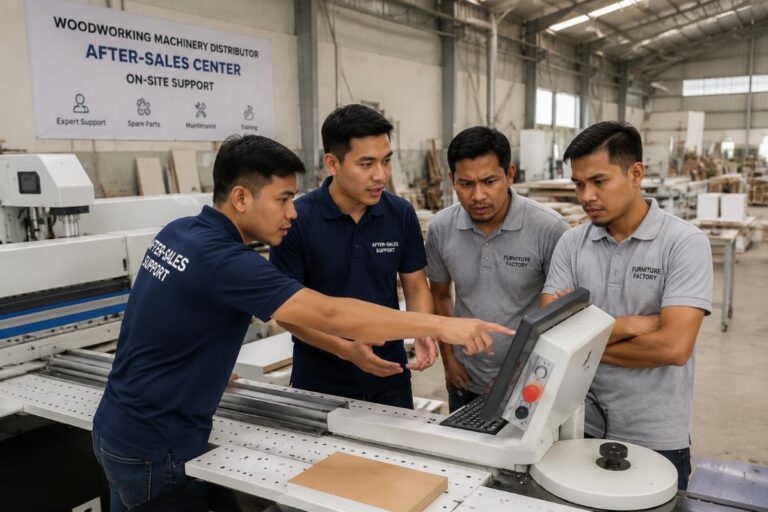
Today, the video installation guidance package is paired with a remote diagnostics protocol. Using a combination of live video call, screen sharing, and annotated PLC parameter screenshots, our after-sales team can identify most faults within a single session. The operator shows the machine on camera, we walk through the diagnostic tree, and the relevant clip from the video package is pulled up instantly.
A furniture workshop in Nigeria reported an edge banding quality issue — the trimmed edge showed micro-chipping. Through a remote video session, we identified that the pre-milling cutter was installed in the wrong direction. The operator pulled up the pre-milling module from the video installation guidance package, corrected the installation, and resumed production the same afternoon.
Every machine we ship carries a twelve-month warranty and lifetime spare parts supply. The video library is updated continuously — if a new fault pattern emerges, we record a fix clip and push it to all existing customers running the same model. This turns the video installation guidance package into a living knowledge base, not a static handover document.
Conclusion
Electrical mismatch and language barriers are the true hidden costs of cross-border machinery delivery — not mechanical accuracy.
A structured video installation guidance package, built around localized PLC interfaces and electrical pre-verification, transforms commissioning from a high-risk gamble into a repeatable, predictable process. It gives the buyer’s team the autonomy to install, operate, and troubleshoot independently, backed by a remote after-sales loop that keeps production running long after the first panel is cut.