Automatic Edge Banding Machine for MDF and Plywood – Distributor Supply
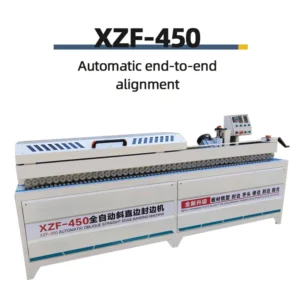
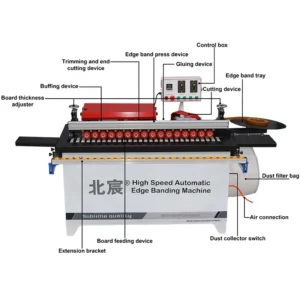
<p><strong>XZF450 Automatic Edge Banding Machine, 9.5KW, 0-12M/min Feed, 0.3-3MM Edge Thickness</strong> — full-function unit with pre-milling, trimming, scraping, and polishing in one pass.</p> <ul> <li>30°/45°/60° edge banding covers standard and bevel-edge furniture segments for broader market reach</li> <li>Pre-milling station with dedicated 4KW motor improves edge adhesion on MDF and particleboard</li> <li>Feed speed and panel range clearly defined for accurate throughput estimation in distributor proposals</li> <li>4000ml glue pot and 0.5-0.7Mpa air requirement simplify installation planning</li> </ul> <p>Backed by four-stage QC with pre-shipment verification and engineer-led configuration support for regional partners.</p>
Features
Quality
Certified
Shipping
Worldwide
Support
24/7 Service
Delivery
Fast Lead Time
In-house manufacturing depth — proprietary cutting mechanism patents and four-stage QC protocols backing every XZF-450 unit shipped, giving distributors verifiable quality claims when presenting to end-user factories.
Technical Specifications
| Parameter | Value |
|---|---|
| Model | XZF-450 |
| Product Type | Automatic Edge Banding Machine |
| Total Power | 9.5 kW |
| Voltage | 380V / 415V (50Hz/60Hz to be confirmed) |
| Pre-milling Motor | 4 kW |
| Trimming Power | 2.2 kW × 2 |
| Polishing Power | 0.4 kW × 2 |
| Vacuum Power | 550 W |
| Feed Speed | 0–12 m/min |
| Edge Banding Height | 0–50 mm |
| Edge Banding Thickness | 0.3–3 mm |
| Minimum Sheet Length | 30 cm |
| Minimum Sheet Width | 15 cm |
| Glue Pot Capacity | 4000 ml |
| Air Source Pressure | 0.5–0.7 MPa |
| Standard Stations | Pre-milling, 30°/45°/60° edge banding, trimming, scraping, polishing, high-power vacuuming |
| Control Language Options | Chinese, English (Spanish and other languages customizable) |
| Plug Options | EU, USA, AU, UK |
| Product Size | 300 × 65 × 135 cm |
| Product Weight | 430 kg |
Application Suitability
| Application | Material or Output |
|---|---|
| Cabinet door production | MDF and melamine-faced particleboard with PVC or veneer edge banding |
| Custom furniture panel processing | Plywood and blockboard requiring 45-degree bevel edge finishing |
| Wardrobe and storage unit manufacturing | Solid wood panels and polymer door components |
| Medium-volume workshop output | Batch runs across mixed panel substrates at feed speeds up to 12 m/min |
Why the Voltage Question Must Come Before the Container Booking
Confirming local grid standards at the quotation stage prevents three-week commissioning delays that erode distributor margins and customer trust.
I worked through a situation last year where a Middle East customer received a 45-degree PVC edge bander that could not power on at the facility. The local grid ran at a frequency the machine was not configured for, and sourcing a compatible transformer on-site took weeks. That delay fell on the edge banding machine distributor who sold the equipment, not the factory that built it. When you are stocking or indenting machines for a regional market, the voltage and frequency confirmation needs to sit inside the formal quotation document before any deposit changes hands [NEED_CITE: voltage and frequency standards by export market]. The XZF-450 is configurable across 380V and 415V inputs, but the exact frequency must be locked in early to avoid exactly this kind of on-site standstill.
Territory Coverage and Model Positioning
An edge banding machine distributor entering a new region needs to present a model range that covers the majority of local workshop requirements without over-committing to inventory. The XZF-450 occupies the mid-tier position where most cabinet and custom furniture factories operate — it handles standard 90-degree edge banding alongside 30-degree and 45-degree bevel work, which means a single machine model addresses both conventional and contemporary furniture segments. This reduces the number of SKUs a distributor must demonstrate and stock parts for, while still covering the panel thickness and feed speed range that typical production environments demand.
Spare Parts Planning for First-Year Operations
Distributor profitability on service calls depends on having the right consumables and wear parts on the shelf when a customer phones. The XZF-450 uses a 4000 ml glue pot, standard trimming cutters at 2.2 kW each, and polishing wheels that require periodic replacement depending on daily run hours. Mapping these consumables against the expected installed base in your territory lets you build a first-year stocking list before the first container ships. Having scraper blades, polishing buffs, and glue pot heating elements available locally is what separates a distributor who retains service contracts from one who loses accounts to faster-responding competitors [NEED_CITE: typical wear component replacement intervals in panel edge banding].
Reading the Spec Sheet Against Actual Workshop Conditions
The pre-milling station on this unit runs on a dedicated 4 kW motor, which matters when your customers are processing MDF and particleboard — these substrates often have surface irregularities from the panel saw cut that compromise glue adhesion if not milled clean before the banding applies. Feed speed ranges from 0 to 12 m/min, and the minimum sheet dimensions of 30 cm length by 15 cm width define the lower boundary of what this machine will accept through the feed chain. For a distributor writing proposals to furniture factories, these numbers let you calculate realistic daily throughput based on the customer's average panel size rather than relying on generic output claims. The edge banding thickness range of 0.3–3 mm covers thin PVC through to thicker solid wood lipping, giving your sales team a single machine recommendation for most enquiries that come across the desk.
The Cost of Skipping the Configuration Conversation
When an edge bander arrives with a control panel in a language the workshop operator cannot read, commissioning stalls until someone reconfigures the interface or sources a translator. When feed height compatibility was never checked against the customer's existing panel saw output, the machine physically cannot accept the workpieces it was purchased to process. These are not manufacturing defects — they are configuration failures that happen when the pre-order conversation stays at the price level and skips the operational detail. Distributors absorb the cost of these oversights through return shipping, on-site engineer visits, and customer goodwill credits that never appear on the original invoice [NEED_CITE: common commissioning failures in imported woodworking machinery].
What Manufacturing Depth Means for Your Territory
The XZF-450 is built in a 10,000 square metre facility with 60 engineers and over 800 production staff, which translates to direct technical access when your service team encounters an unfamiliar fault condition. The four-stage QC process — incoming material, in-process, finished product, and pre-shipment verification — means the test record you receive before container loading reflects actual machine performance rather than a batch-level assumption. Patented cutting mechanisms with ±0.02 mm tolerance give your sales presentations a verifiable engineering claim instead of a generic precision statement. Voltage customization from 110V to 440V and multilingual control panels are handled as standard configuration items, not special requests that add weeks to lead time. An engineer-led configuration recommendation with formal quotation within 24 hours means your team can respond to end-user enquiries while the prospect is still comparing options.
Documentation & Verification
- CE declaration of conformity covering the XZF-450 for EU market entry and customs clearance
- Electrical schematic confirming voltage and frequency match for the destination grid before dispatch
- Factory test record on customer-specified panel substrates showing edge adhesion and trim quality
- Operation and maintenance manual configured in the agreed language for end-user operator training
- Spare parts list with part numbers supporting distributor inventory planning and reorder cycles
- Packing photographs documenting machine condition at the point of container loading
Installation, Commissioning & Support
- Dedicated 9.5 kW power circuit required at the installation site, confirmed against local supply capacity
- Air compressor delivering 0.5–0.7 MPa to be positioned within hose reach of the machine's inlet
- 300 × 65 × 135 cm footprint to be mapped against workshop floor plan before delivery scheduling
- Language-configurable control panel set during commissioning to match operator proficiency
- Pre-milling and trimming station calibration verified on customer's own panel stock during first run
- Glue pot heating cycle and 4000 ml capacity reviewed during operator handover training
Starting the Distributor Conversation
To build a proposal that holds up through installation and into the first year of service, we work from your market's typical panel substrates, the voltage and frequency standards in your territory, and the workshop scale your customer base represents. Share the panel types and thickness ranges most common in your region, the language your service team operates in, and whether you are stocking units or indenting against confirmed orders — the configuration follows from those inputs rather than from a catalogue default.
Frequently Asked Questions
Q: What territory support and exclusivity terms are available for regional distributors? A: Territory arrangements are structured around your market's volume commitment and service capability. We discuss exclusivity scope, minimum annual order quantities, and the model mix that fits your customer base during the initial partnership conversation. Each agreement defines the geographic boundary and the support resources allocated to your region.
Q: How does the model mix recommendation work for a distributor entering a new market segment? A: We review the panel substrates, furniture types, and production volumes typical in your target market, then map XZF series models to cover entry-level through full-function requirements. This prevents you from over-stocking narrow-application machines while leaving common customer requests unaddressed.
Q: What spare parts backup and lead times should a distributor plan for? A: The spare parts list for the XZF-450 includes wear components like trimming cutters, polishing wheels, scraper blades, and glue pot elements. We recommend first-year stocking quantities based on your projected installed base, and standard replenishment lead times are confirmed at the point of initial order.
Q: Is technical training available for the distributor's own installation and service team? A: Yes. Training covers machine commissioning procedures, common fault diagnosis across the pre-milling through polishing stations, and consumable replacement protocols. This can be arranged at the factory before your first shipment or during the initial installation in your territory.
Q: How is the machine packed and documented for customs clearance in different destination countries? A: Each XZF-450 ships with packing photographs, commercial invoice, packing list, and the CE declaration where applicable. Electrical schematics and voltage confirmation documents are included to satisfy import inspection requirements specific to your destination market.
Request a Quote
Fill in the form below and our team will get back to you within 24 hours.