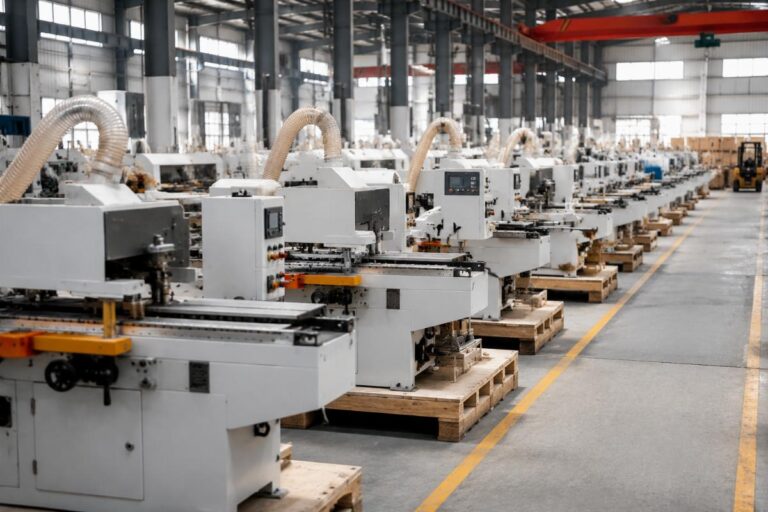
Wholesale Multi-Boring Machine with Container Discount
Lower unit price per machine rarely means lower total landed cost — the real savings hide in how you mix the container.
Sourcing a wholesale multi-boring machine at container-level pricing requires locking three hard parameters before price negotiation: spindle configuration matched to production volume, voltage and air-source adaptation to the destination grid, and OEM customization thresholds that disappear once a full container is committed. Buyers who skip this sequence routinely pay for electrical rework at the port or idle spindles on the shop floor.
I still remember a shipment to a cabinet workshop near Riyadh. The buyer ordered a six-row unit based on a quotation for a standard 23-spindle model, assuming the voltage specs were interchangeable across the Gulf. When the container cleared customs, the machines sat silent — Saudi industrial power runs at a different frequency than what the factory default was set for. I flew out to rewire the control cabinets on the shop floor, burning through half a month of production schedule. Since then, every buying guide I draft puts spindle count, voltage, and air-source specs before any pricing discussion. [NEED_CITE: IEC 60038 standard voltage and frequency classifications for industrial power supply across MENA and African markets]
Getting the container load right starts with understanding what each configuration actually does — and what it cannot do.
What Spindle Configuration Fits Your Production Volume?
Choosing between 23-spindle, 27-spindle, and six-row configurations is not about buying more capacity — it is about matching the machine to your cabinet drilling workflow, because the wrong spindle layout creates bottlenecks that no speed adjustment can fix.
The three mainstream configurations serve fundamentally different production scenarios. A 23-spindle multi-boring machine is designed for single-station supplementary hole drilling — hinge cups, shelf pins, and dowel holes on individual panels. A 27-spindle unit extends that coverage with additional vertical and horizontal heads, suitable for workshops running mixed cabinet sizes without frequent manual repositioning. A six-row boring machine, by contrast, is built for inline production: it drills all hinge, shelf, and construction holes on a cabinet side panel in a single pass, making it the backbone of a connected cabinet line. [NEED_CITE: industry white paper on panel furniture production line capacity and equipment configuration matching]
Here is how the three configurations compare across the dimensions that matter for wholesale buyers:
| Dimension | 23-Spindle | 27-Spindle | 6-Row Configuration |
|---|---|---|---|
| Typical Workflow | Single-station supplementary drilling | Mixed-size cabinet drilling | Inline cabinet side-panel drilling |
| Spindle Coverage | Standard horizontal and vertical | Extended multi-angle coverage | Full-pass simultaneous drilling |
| Line Integration | Standalone or manual transfer | Semi-integrated | Full conveyor-line compatible |
| Operator Skill Required | Moderate | Moderate to advanced | Basic after setup |
| Container Loading Density | Higher units per container | Moderate units per container | Fewer units, higher individual value |
A mid-scale panel furniture factory in Southeast Asia approached us to replace their aging standalone drills. They initially requested the highest spindle count available, assuming it would future-proof the purchase. After reviewing their daily panel throughput and cabinet mix, we recommended a six-row configuration instead — the 27-spindle units they were considering would have overlapped heavily with their existing 23-spindle machines, leaving significant capacity unused. The switch reduced their per-panel drilling time noticeably and allowed them to integrate the new unit directly into their existing conveyor line. [NEED_CITE: case study data on panel furniture factory production line upgrade and equipment selection criteria]
The key takeaway for wholesale buyers: do not let the spindle number alone drive your specification sheet. Map your daily cabinet output, panel mix, and existing line layout first, then match the configuration. A container full of mismatched machines costs more in idle time than any unit-price discount can offset.
How Does Container Volume Unlock Tiered Pricing?
The wholesale multi-boring machine price list is only the starting point — the real cost advantage emerges when you structure the container load to combine machines, spare parts, and consumables in a ratio that minimizes per-unit landed cost.
Most buyers focus exclusively on the per-machine quotation. But the total cost of getting a multi-boring machine operational at an overseas factory includes freight, port handling, customs duties, spare parts procurement, and consumable restocking during the first production cycle. A full container order triggers a tiered pricing structure that reduces the base machine price substantially compared to single-unit or half-container orders. More importantly, it allows you to pack spare parts kits, drill bits, and wear components into the same container at marginal additional freight cost — items that would otherwise require separate LCL shipments at significantly higher per-cubic-meter rates. [NEED_CITE: international freight forwarding cost comparison between FCL full container load and LCL less-than-container load shipments]
Consider a distributor in West Africa who placed an initial trial order of a small number of units. The per-unit freight and customs clearance cost was high relative to the machine price. When they returned for a repeat order, they committed to a full container — mixing the wholesale multi-boring machine units with a comprehensive spare parts package and a full carton of consumable drill bits and collets. The base machine price dropped through the wholesale tier, and the spare parts and consumables rode in the same container at essentially no incremental freight cost. The result was a noticeable reduction in the per-unit total landed cost, and the spare parts inventory meant the distributor could offer immediate after-sales support to their local buyers without waiting for international shipments.
The container loading calculation follows a straightforward logic: determine how many machines fit based on their packed dimensions, then allocate remaining cubic capacity to spare parts kits and consumables. A typical 40-foot high cube container can accommodate a specific number of six-row units or a larger number of 23-spindle units, with the residual space filled by boxed spare parts and consumable cartons. The exact ratio depends on the machine model and the buyer’s after-sales strategy, but the principle is consistent — every cubic meter of container space should carry value, not empty air. [NEED_CITE: container loading optimization guide for woodworking machinery export shipments]
Which OEM Customizations Are Included at Wholesale Tier?
At full-container order volume, the OEM customization cost for voltage adaptation, PLC language, and factory branding drops to near zero — buyers who negotiate these items separately are paying for what should be bundled.
Many first-time importers assume that requesting a non-standard voltage configuration, a PLC interface in Arabic or Spanish, or a custom factory logo will trigger separate engineering fees and extended lead times. This assumption is outdated for wholesale multi-boring machine orders at container scale. Manufacturers serving the export market routinely build voltage adaptation, multilingual control panels, and private-label branding into their standard production workflow for full-container orders, because the marginal cost of changing a transformer tap or loading a different language file is negligible when spread across an entire container of identical machines.
The standard OEM package at wholesale tier typically includes:
- Voltage adaptation to match the destination country’s industrial power standard — covering the full range from 110V to 440V at either 50Hz or 60Hz, with corresponding transformer and contactor adjustments.
- Multilingual PLC interface — standard offerings include English, Spanish, French, and Arabic, with the control panel labels and touchscreen menus adapted to the buyer’s market.
- Factory branding — logo placement on machine covers, control panels, and packaging, with the buyer’s company name and contact information printed on the shipping marks.
- Power plug and cable specification matched to the destination country’s industrial connector standards.
A distributor in the Middle East who regularly orders full containers of panel furniture production equipment requested Arabic-language PLC panels and 220V/60Hz voltage configuration for every shipment. Because the order volume consistently filled a full container, these customizations were included in the base quotation with no separate engineering charge. The same distributor initially tested the market with a half-container order, where the voltage adaptation was quoted as a separate line item — the per-unit cost was noticeably higher, and the lead time extended because the customization was treated as a special request rather than a standard production parameter. [NEED_CITE: OEM customization cost structure analysis for woodworking machinery export at varying order volumes]
The lesson: if your order volume reaches full-container scale, treat voltage, language, and branding as standard specifications to be confirmed in the purchase order — not as custom requests to be negotiated.
What Pre-Shipment Checks Prevent Port Delays?
A hundred-percent factory run-test combined with逐项 verification of voltage, air-source, and spindle parameters before container sealing eliminates the majority of port-side delays and on-site rework costs.
The most expensive mistake in wholesale multi-boring machine procurement is not choosing the wrong spindle configuration — it is discovering the wrong configuration only after the container has cleared customs at the destination port. Electrical rework at an overseas factory requires either flying a technician out at substantial cost or hiring a local electrician who may not understand the machine’s control logic. Either option burns weeks of production time and generates costs that dwarf any unit-price savings achieved during negotiation.
The pre-shipment verification protocol should cover the following checkpoints:
- Voltage and frequency confirmation — run the machine on a power supply matching the destination specification, not the factory’s local grid. Verify that all contactors, transformers, and motor windings are rated for the target voltage and frequency.
- Air-source pressure and connector verification — confirm that the pneumatic system operates at the pressure standard used in the destination country, and that the air inlet connector matches the local hose and fitting standard. [NEED_CITE: ISO 4414 pneumatic fluid power standard for industrial air supply connections and pressure ratings]
- Spindle runout and drilling accuracy test — run a test panel through all spindle heads and measure hole position accuracy and hole wall quality. Any spindle with excessive runout must be replaced before shipping, because field replacement requires specialized tooling that the buyer may not have on site.
- PLC language and parameter verification — power up the control panel and confirm that the interface language matches the order specification, and that all drilling parameters are set to the buyer’s production requirements.
- Packaging and container loading inspection — verify that all machines are securely bolted to the container floor, that spare parts kits are packed separately and labeled, and that the container seal number matches the shipping documentation.
A buyer in Latin America received a container of multi-boring machines without requesting a pre-shipment voltage test. The factory had run the machines on their local 380V/50Hz grid, but the destination country used 220V/60Hz. The machines arrived looking perfect — until the buyer tried to power them on. The control boards were compatible, but the transformers and contactors were not rated for the lower voltage at the higher frequency. The buyer spent a mid-five-figure sum on local electrical rework and lost nearly a month of production. [NEED_CITE: case documentation on woodworking machinery electrical compatibility failures in Latin American import market]
The fix is simple but non-negotiable: require the manufacturer to run every machine on a power supply matching your destination specification, document the test with video, and include the test report in the shipping file. This single step prevents the majority of costly on-site surprises.