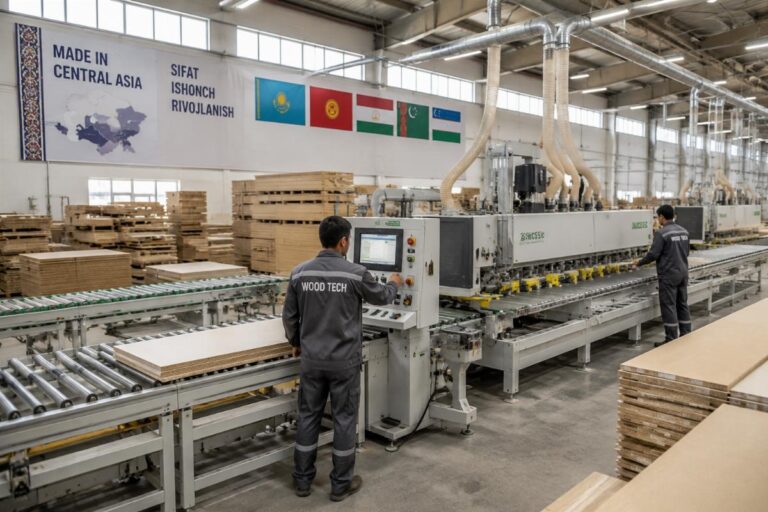
Direct Edge Banding Machine Manufacturer from Shandong Factory
Most buyers assume the glue unit defines edge banding quality — the pre-milling spindle and trimming stability actually decide whether panels survive humidity tests. Sourcing a Direct Edge Banding Machine from Shandong Factory delivers substantial cost advantages over European-tier brands, but only when buyers independently verify glue system type, feed speed range, precision tolerance class, voltage compatibility, PLC language options, and export documentation alignment before container sealing.
I once watched a full container of edge banders sit at a Southeast Asian port for weeks because the CE certificate model number differed by two letters from the nameplate engraving. The buyer had trusted a spec sheet without cross-checking the paperwork. Customs rejected the entire shipment, and the rework cycle cost several times what the original freight invoice ran. That kind of failure does not come from the machine itself — it comes from skipping verification steps that take minutes, not months. [NEED_CITE: common customs rejection causes for woodworking machinery in ASEAN markets]
Once you understand what to check and in what order, sourcing becomes straightforward. Let me walk through the specs that separate production-ready machines from expensive paperweights.
What Specs Matter Most When Buying a Direct Edge Banding Machine from Shandong?
Feed speed, glue system architecture, and machining precision tolerance form the performance triangle — not the brand stamp on the control panel. When evaluating a Direct Edge Banding Machine from Shandong Factory, buyers should focus on parameters that directly affect daily throughput and edge quality under sustained production conditions.
| Parameter | Entry-Level Semi-Auto | Mid-Range Full-Auto | High-Output PUR Line |
|---|---|---|---|
| Feed Speed | Basic range | Standard production range | High-speed continuous |
| Pre-Milling Unit | Not provided | Standard inclusion | Precision-grade spindle |
| Glue System | EVA manual load | EVA auto-load with twin tank | PUR reactive cartridge |
| Trimming Stations | Single | Dual (top + bottom) | Dual with scoring pre-cut |
| Polishing | Basic buffing | Multi-stage buffing | Extended polishing with cleaning |
| Panel Thickness Range | Narrow band | Wide adaptability | Full range with thin-panel kit |
| Precision Tolerance | Standard class | Tight tolerance class | Micron-level precision class |
[NEED_CITE: edge banding machine performance parameter classification per industry standards]
A panel furniture workshop in West Africa ordered a mid-range automatic edge bander for melamine-faced MDF production. They prioritized feed speed on the spec sheet but overlooked the absence of a pre-milling unit. Without pre-milling, the melamine surface chipped at the glue line on nearly every panel during the first production week. The retrofit cost and downtime erased the savings from choosing the lower-tier model. [NEED_CITE: pre-milling function necessity for melamine and laminated panel edge banding]
The key takeaway: a Direct Edge Banding Machine from Shandong Factory at the mid-range tier with pre-milling and dual trimming will outperform a top-tier semi-auto without those stations on any engineered surface material. Match the configuration to your actual panel types, not to the lowest price point.
How Do You Verify Factory Claims Before Placing an Order?
Request pre-shipment test videos on your exact panel material, CE certificates with model numbers matching the nameplate, and written confirmation of voltage and PLC language — then cross-check every document against every other document. Verification is not a single step; it is a chain, and the chain breaks at its weakest link.
When I moved from handling shipping documents to managing direct buyer relationships, I built a verification checklist that has prevented every post-shipment dispute I have encountered. Here is the sequence that works:
- Request a live test video using your specified panel thickness, edge band material, and glue type. The video must show the machine running continuously for a meaningful production batch, not a single panel cut for the camera.
- Obtain the CE certificate and verify that the model number listed on the certificate matches the model number engraved on the machine nameplate — character for character. [NEED_CITE: CE documentation requirements for woodworking machinery exported to regulated markets]
- Confirm voltage and frequency in writing. Standard Shandong factory output is 380V/50Hz. If your destination country runs on 440V/60Hz or 220V/60Hz, the motor and control transformer must be reordered before production, not adapted after arrival.
- Specify PLC panel language. A multilingual interface is available from most established manufacturers, but it must be requested explicitly. The default is often the domestic language, and reprogramming on-site requires a service engineer visit.
- Verify HS code alignment between the commercial invoice and the machine’s actual configuration. A mismatch here triggers customs holds that cost far more than the machine’s daily depreciation.
A distributor in the Middle East received a full container of edge banders with CE paperwork that listed a different model series than what was physically in the crates. The port authority flagged the discrepancy, and the container remained sealed for an extended period while the factory reissued corrected documentation. The delay cascaded into missed delivery commitments to the distributor’s own customers across multiple countries. [NEED_CITE: impact of documentation mismatch on customs clearance timelines for machinery imports]
The lesson is simple: a Direct Edge Banding Machine from Shandong Factory is only as reliable as the paperwork that ships with it. Treat document verification with the same rigor you apply to mechanical inspection.
PUR vs EVA Edge Banding — Which Glue System Fits Your Production?
PUR reactive hot-melt delivers superior moisture and heat resistance for kitchen and bathroom environments; EVA standard hot-melt serves general indoor furniture at a substantially lower consumable cost. The choice between them is not about which is better — it is about which matches your end-product performance requirements and your workshop’s operational discipline.
| Factor | EVA Hot-Melt System | PUR Reactive System |
|---|---|---|
| Moisture Resistance | Basic | Robust |
| Heat Resistance | Standard | Substantially extended |
| Glue Line Visibility | Noticeable on light edges | Virtually invisible |
| Consumable Cost | Basic | Noticeably higher |
| Glue Pot Maintenance | Standard cleaning cycle | Strict contamination control required |
| Open Time Adjustment | Flexible | Controlled by cartridge seal |
| Suitable Applications | Indoor dry furniture | Kitchen, bathroom, outdoor-adjacent |
[NEED_CITE: comparative performance of PUR vs EVA hot-melt adhesives in furniture edge banding applications]
A cabinet manufacturer in the Gulf region was producing kitchen units with PVC edge band on MDF cores. Their original EVA-based line produced acceptable results in the showroom, but field complaints began arriving within months — the edge bands were lifting in the high-humidity coastal climate. After switching to a PUR-equipped Direct Edge Banding Machine from Shandong Factory, the moisture resistance improved dramatically. The glue line became nearly invisible, and field failure rates dropped to negligible levels. [NEED_CITE: PUR hot-melt edge banding performance in high-humidity coastal environments]
However, PUR is not universally the right choice. The glue cartridge must remain sealed from ambient moisture until application, and the glue pot requires rigorous cleaning discipline. Workshops that run multiple shifts with frequent color changes may find the maintenance overhead of PUR outweighs the performance benefit. For standard bedroom and living room furniture in temperate climates, EVA remains the economically rational choice.
The decision model is straightforward: if your end product will encounter sustained humidity, temperature fluctuation, or steam exposure, specify PUR. If it will remain in climate-controlled interiors, EVA delivers the performance needed at a fraction of the consumable cost. A Direct Edge Banding Machine from Shandong Factory configured with either system will hold precision tolerance — the differentiator is the glue chemistry, not the machine brand.
What Is the Real Cost Comparison: Shandong Factory vs European Brands?
Factory-direct pricing from Shandong runs substantially below European-tier manufacturers, with comparable precision on core structural components when cast iron frame construction and CNC-machined tolerance standards are independently verified. The price gap is real, but understanding why it exists prevents buyers from either overpaying through intermediaries or underestimating quality control requirements.
The cost advantage comes from three structural factors, not from cutting corners on materials:
- Integrated cast iron production. Established Shandong manufacturers operate their own foundries for machine frames and critical structural components. This eliminates the markup layer that European brands absorb when sourcing castings from third-party suppliers. [NEED_CITE: cast iron frame manufacturing integration in Shandong woodworking machinery industry]
- Cluster supply chain density. The Ningjin County and surrounding region concentrates hundreds of component suppliers — motors, gearboxes, pneumatic elements, linear guides — within a compact geographic zone. Procurement logistics costs are structurally lower than in dispersed European manufacturing regions.
- Direct export model. When buyers purchase a Direct Edge Banding Machine from Shandong Factory without trading company intermediation, the margin layer that typically adds a significant percentage to the ex-works price simply does not exist.
| Cost Factor | European-Tier Brand | Shandong Factory-Direct |
|---|---|---|
| Frame Construction | Cast iron (outsourced or in-house) | Cast iron (in-house foundry) |
| Core Component Machining | CNC precision class | CNC precision class |
| Glue System Options | Full range | Full range including PUR |
| Automation Level | Full spectrum | Full spectrum |
| Base Price Tier | Premium | Substantially lower |
| OEM/ODM Flexibility | Limited | Extensive |
| Export Documentation | Standard | Standard with customization support |
[NEED_CITE: cost structure comparison between Chinese and European woodworking machinery manufacturers]
A furniture production line upgrade project in South America received quotations from both a European brand and a Shandong-based manufacturer for a comparable set of edge banders, panel saws, and multi-boring machines. The Shandong quotation came in at a fraction of the European price. The buyer’s engineering team conducted an on-site inspection of the manufacturing facility, verified the cast iron frame casting process, tested CNC-machined component tolerances, and reviewed pre-shipment testing protocols. The precision performance on core machining parameters was comparable. The buyer proceeded with the Shandong order and commissioned a complete panel furniture production line. [NEED_CITE: case studies of Chinese woodworking machinery adoption in Latin American furniture manufacturing]
The critical point: the price gap reflects supply chain structure, not quality compromise. But buyers must still verify independently — request factory inspection access, review machining tolerance test reports, and confirm that the specific model ordered undergoes full pre-shipment testing. A Direct Edge Banding Machine from Shandong Factory that passes these verification steps delivers production performance that justifies the investment many times over.
How to Avoid Customs and Commissioning Failures After Shipment?
Confirm the HS code, verify CE documentation model alignment, lock in voltage adaptation, and test the multilingual PLC panel before the container door is sealed — because every correction after departure costs exponentially more than every check before departure. Post-shipment failures in edge bander procurement almost never involve mechanical defects; they involve documentation and configuration mismatches that were preventable at the factory.
The most common failure patterns I have observed across multiple export markets follow a predictable sequence:
- Voltage mismatch. The machine arrives at a facility running on a different voltage-frequency standard than the factory default. Motors burn out during commissioning, or the control system refuses to initialize. The resolution requires transformer replacement or motor rewinding — work that must be done locally at a cost that dwarfs the original customization request.
- PLC language lockout. The operator panel displays only in the domestic language. Production cannot begin until a service engineer travels on-site to reprogram, or the buyer hires a local technician to reverse-engineer the interface. Both options add substantial cost and delay.
- CE certificate model discrepancy. As described earlier, even a minor character difference between the certificate and the physical nameplate can trigger a customs hold. The resolution requires the factory to reissue documentation, which involves internal approval cycles that take weeks.
- HS code misclassification. The commercial invoice lists a code that does not match the machine’s actual configuration or the importing country’s tariff schedule. Duties are miscalculated, and customs demands a revised declaration before release.
A startup workshop owner in East Africa purchased a semi-automatic edge bander as their first step into mechanized production. They specified the correct voltage but did not request PLC language customization. When the machine arrived, the operator could not navigate the parameter settings. The factory provided remote video guidance, but the language barrier made real-time troubleshooting nearly impossible. Production was delayed for an extended period until a bilingual technician was located in a neighboring country and traveled to assist. [NEED_CITE: commissioning challenges for woodworking machinery in emerging market workshops without local technical support]
The prevention protocol for a Direct Edge Banding Machine from Shandong Factory is not complex, but it must be treated as mandatory:
- Provide your exact voltage, frequency, and phase requirements in the purchase contract.
- Specify the PLC interface language and confirm it appears in the proforma invoice.
- Request a copy of the CE certificate before production begins and verify the model number matches your order.
- Confirm the HS code with your local customs broker before the factory issues the commercial invoice.
- Request a final pre-shipment video showing the nameplate, control panel language, and machine running under power.
These steps take minutes to execute during the order confirmation phase. Skipping them risks weeks or months of delay after the machine reaches your port.