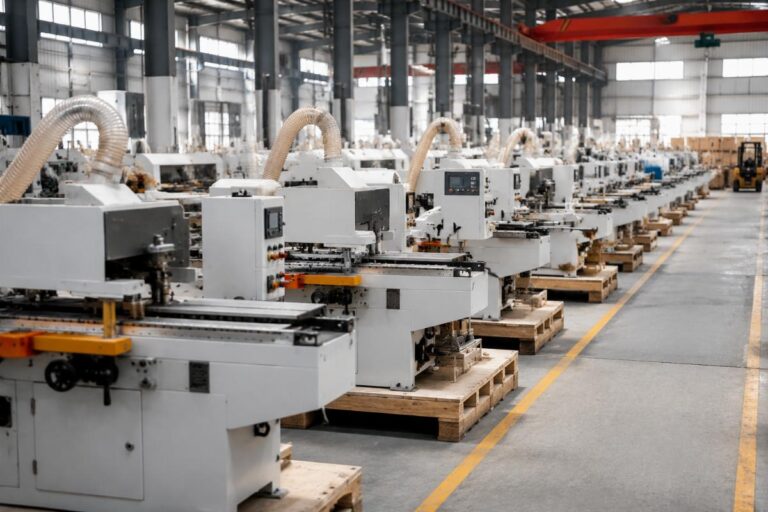
Edge Banding Machine Supplier – Ruiqi Woodworking Machinery for Sale
Most small workshop owners buy the cheapest manual edge bander they can find — then quietly lose money every single day for a year before realizing the mistake.
The right starter package for a small woodworking business is a semi-auto edge bander paired with an entry-level 1325 CNC router and a multi-boring machine — not the most expensive fully automatic line, and certainly not a single manual unit pretending to be enough. This combination delivers the fastest return on investment for startups in emerging markets, balancing automation, floor space, and budget before scaling up.
I still remember a shipment we sent to a small cabinet workshop in East Africa a few years back. They had been hand-banding edges with a manual roller for years, and when they finally upgraded to our semi-auto straight-line edge bander, their daily output jumped noticeably — and the payback period on the machine cost was measured in months, not years. But the real lesson came from a different order, one that went to a startup furniture studio in Southeast Asia. They bought a 1325 CNC router and a 23-spindle multi-borer together, and within the first year, their order delivery cycle shortened dramatically while panel yield improved visibly. [NEED_CITE: typical payback period for semi-auto edge banding upgrade in small cabinet workshops]
These two stories, and dozens like them across Africa, Latin America, and Southeast Asia, shaped how I now think about small workshop machinery. The pattern is always the same: the right-sized machine, bought as a coordinated package, outperforms both the cheapest single unit and the over-engineered fully automatic line. Let me walk you through how to make that call.
What Wood Machinery Does a Small Business Actually Need?
The minimum viable equipment set depends entirely on what you make — cabinets, doors, or custom furniture — and buying outside that scope is the fastest way to burn cash.
A cabinet-focused startup needs three things above all else: clean edge banding, precise panel cutting, and reliable drilling. A door manufacturer, on the other hand, will prioritize CNC engraving and tenoning over edge banding speed. And a custom furniture workshop making one-off pieces leans heavily on CNC routing flexibility rather than high-volume boring. [NEED_CITE: minimum equipment requirements by furniture product category for small workshops]
Here is how the logic breaks down in practice:
- Cabinet and wardrobe workshops need a straight-line edge bander (semi-auto minimum), a panel saw or entry CNC router for nesting, and a multi-boring machine for hinge and shelf pin holes.
- Door manufacturers need a CNC door engraving center, a boring machine for lock and hinge holes, and an edge bander for door perimeters — but door edge banding tolerances are looser than cabinet tolerances, so a mid-range semi-auto often suffices.
- Custom furniture studios making mixed small-batch work need a versatile 1325 CNC router with ATC capability and a compact multi-borer, with edge banding handled by a semi-auto unit that can switch between panel thicknesses quickly.
I once worked with a buyer in West Africa who initially wanted a fully automatic edge bander because he had seen one at a trade fair. After walking through his actual daily order volume — a few dozen cabinet sets per week — we redirected him to a semi-auto model. He later told me the monthly output matched his needs perfectly, and the capital he saved went into better tooling and spare parts. [NEED_CITE: production capacity comparison between semi-auto and fully automatic edge banders for small batch operations]
The takeaway is straightforward: map your top three products first, then match the machine category to those products. Anything beyond that is premature.
Semi-Auto vs Fully-Auto Edge Banders: Which Fits Your Budget?
The price gap between a semi-auto and a fully automatic edge bander is substantial — but the efficiency gap matters more, and it closes the payback window faster than most buyers expect.
When I first started in this business, I assumed small shops should always start with manual or basic semi-auto units. Then I watched a small workshop in Latin America upgrade from a manual roller to a semi-auto edge bander with pre-milling and trimming functions. Their edge quality jumped to a level that let them charge noticeably more per cabinet set, and the daily throughput increased by a clear multiple. The extra capital was recovered well within a year.
Here is how the two categories compare across the dimensions that actually matter to a small buyer:
| Parameter | Semi-Auto Edge Bander | Fully-Auto Edge Bander |
|---|---|---|
| Feeding speed | Moderate, operator-assisted | High, continuous automated feed |
| Pre-milling function | Available on mid-range models | Standard |
| Edge trimming precision | Good for standard panels | Excellent, tight tolerance |
| Buffing and cleaning | Basic to mid-level | Full multi-station finishing |
| Daily throughput suitability | Small to medium batch | Medium to high volume |
| Floor space requirement | Compact | Larger footprint |
| Investment level | Entry-friendly | Significant capital outlay |
| Operator skill needed | Moderate | Lower per-unit skill, higher setup skill |
[NEED_CITE: edge banding speed and throughput comparison across automation levels]
The common misconception is that buying the cheapest machine saves money. In reality, the efficiency premium of a semi-auto unit over a manual one pays for itself within months through higher output and fewer rejected panels. And the gap between a semi-auto and a fully automatic unit only justifies itself once your daily volume consistently fills the automatic machine’s capacity — which, for most startups, takes years, not months.
For a small business, the semi-auto edge bander sits in the sweet spot: enough automation to deliver professional edge quality and respectable throughput, without the capital burden and floor space demand of a fully automatic line.
CNC Router Sizing for Small Workshops: 1325 vs 1530
The 1325 CNC router is the default workhorse for small workshops — and the 1530 only makes sense when your panel format or order mix genuinely demands the extra bed length.
The 1325 model (working area roughly 1300 × 2500 mm) aligns neatly with standard sheet sizes used across most emerging markets — 1220 × 2440 mm panels fit comfortably with room for toolpath clearance. The 1530 model adds bed length, which helps when processing longer door blanks or when nesting multiple parts in a single run. But the larger bed also means higher machine cost, more floor space, and slightly higher spindle load demands. [NEED_CITE: standard panel size compatibility with 1325 and 1530 CNC router working areas]
Here is how the two sizes stack up for typical small workshop scenarios:
| Factor | 1325 CNC Router | 1530 CNC Router |
|---|---|---|
| Standard panel fit | Excellent, minimal waste | Excellent, extra length for long blanks |
| Spindle power range | Adequate for most nesting tasks | Higher capacity for dense material |
| ATC configuration | Widely available | Widely available |
| Vacuum table zones | Sufficient for standard sheets | More zones for larger sheets |
| Floor space demand | Moderate | Noticeably larger |
| Price positioning | Entry-friendly | Higher investment |
[NEED_CITE: CNC router bed size selection logic based on panel format and order type]
A startup furniture studio I advised in Southeast Asia initially considered the 1530 because "bigger is better." After reviewing their order mix — mostly standard cabinet components with occasional door panels — the 1325 with ATC covered every job they had. The money saved on the machine went into a quality multi-borer, which improved their overall line balance far more than the extra bed length would have.
The rule of thumb: if your standard panel fits the 1325 bed with clearance, start there. Upgrade to the 1530 only when order data consistently shows you need the extra length.
How to Build a Starter Production Line Under Budget
A phased starter package — semi-auto edge bander plus entry CNC router plus multi-borer — delivers coordinated throughput that far exceeds the sum of three standalone machines bought separately.
The mistake I see repeatedly is a buyer purchasing one machine at a time, each from a different supplier, with no thought to how the units interact on the shop floor. The result is bottleneck shifting: the CNC router outpaces the edge bander, or the multi-borer cannot keep up with the panel flow from the saw. The line never reaches its theoretical capacity.
A coordinated package solves this by matching the throughput rhythm of each machine. Here is a practical phasing path for a small cabinet or furniture startup:
- Phase 1: Semi-auto straight-line edge bander with pre-milling and trimming. This single upgrade from manual banding transforms edge quality and daily output immediately.
- Phase 2: Entry-level 1325 CNC router with ATC for nesting-based cutting. This replaces the sliding table saw for panel sizing and adds drilling capability for basic holes.
- Phase 3: Multi-boring machine (23-spindle or 6-row configuration) dedicated to hinge, shelf pin, and cam holes. This frees the CNC router to focus on cutting and profiling.
[NEED_CITE: phased machinery investment model for small panel furniture startups]
The budget allocation logic matters as much as the machine selection. A healthy split directs the majority of capital to the primary processing machines (edge bander, CNC router, multi-borer), a moderate share to auxiliary equipment (dust collection, air compressor, panel supports), and a reserved portion for tooling and consumables (router bits, edge banding rolls, drill bits). Skipping the tooling budget is a recurring error — I have seen shops buy excellent machines and then struggle because they could not afford quality cutters.
This is where a turnkey starter package from a single supplier makes a real difference. When the edge bander, CNC router, and multi-borer are configured and tested as a coordinated set, the throughput balance is built in — and the buyer avoids the trial-and-error of mixing mismatched units.
What to Verify Before Shipping Machinery Overseas
Voltage adaptation, PLC language, and pre-shipment testing are not optional extras — they are the difference between a machine that runs on day one and a machine that eats your entire order profit in on-site debugging costs.
Early in my career, I was part of a shipment to the Middle East where the edge bander arrived with a PLC panel entirely in Chinese and a voltage configuration that did not match the local supply. The buyer could not operate the machine. We flew an engineer out, the trip cost was substantial, and the margin on the entire order was wiped out. That single experience changed how I handle every overseas shipment.
Here is the verification checklist that now runs before any machine leaves the factory:
- Voltage confirmation: Match the machine’s electrical configuration to the destination country’s standard supply — whether 220V, 380V, 440V, or local variants. Document the confirmed voltage on the shipping paperwork and the machine nameplate.
- PLC language setting: Set the control panel interface to the buyer’s working language — English, Spanish, French, Arabic, or other local languages. Verify the language is active, not just installed.
- Operation manual: Provide a printed and digital manual in the buyer’s language, covering daily operation, basic troubleshooting, and maintenance schedules.
- Pre-shipment test run: Run the machine with the actual panel type and edge banding material the buyer will use, record the results, and share the test report before loading.
[NEED_CITE: pre-shipment verification checklist for woodworking machinery export]
A buyer in Latin America once told me that the factory’s attention to these details — the Spanish-language PLC, the correct voltage, the video of the test run with his specific edge banding roll — was what made him reorder. The machine worked from day one, and he did not need to hire a local technician to figure out the controls.
These steps cost very little in the grand scheme of an order, but they prevent the kind of on-site failures that destroy margins and reputations. Any serious edge banding machine supplier should treat this checklist as non-negotiable.