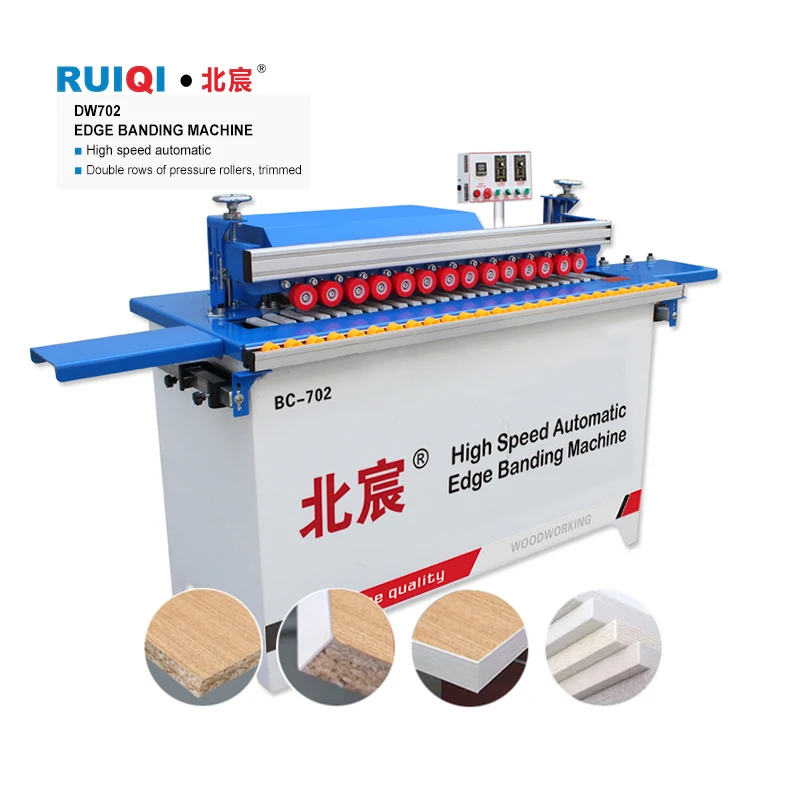
DW702 Edge Banding Machine for MDF Plywood – Wholesale Distributor Supply
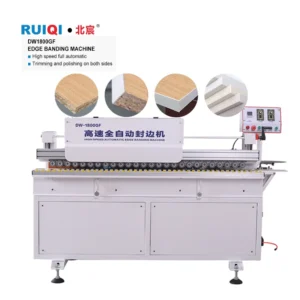
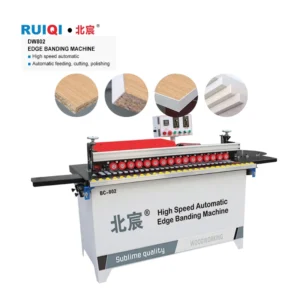
<p><strong>DW702 Automatic Edge Banding Machine, 220V/380V, 0.3–3mm Edge Thickness, 1000ml Glue Pot</strong> — built for MDF, plywood, and particleboard edge finishing with trimming and polishing in one pass. Regional distributors gain a single-source model range from entry-level to full-function, covering joinery shops through cabinet factories without switching suppliers. Every unit ships with pre-verified voltage documentation and multilingual operator manuals.</p>
Features
Quality
Certified
Shipping
Worldwide
Support
24/7 Service
Delivery
Fast Lead Time
Verified Electrical Configuration — the DW702 ships with voltage confirmed at order stage (110V–440V customization as standard) and pre-shipment electrical verification, preventing costly on-site failures for regional distributors.
Technical Specifications
| Parameter | Value |
|---|---|
| Model | DW702 |
| Product Type | Automatic Edge Banding Machine |
| Total Power | 3800W |
| Voltage & Frequency | 220V/380V/customization (50Hz/60Hz to be confirmed at order) |
| Trimming Power | 800W × 2 |
| Polishing Power | 180W × 2 |
| Transmission Power | 140W |
| Vacuum Hold-Down Power | 1200W |
| Edge Feed Power | 20W |
| Edge Banding Thickness Range | 0.3–3 mm |
| Edge Banding Height Range | 0–50 mm |
| Minimum Sheet Length | 25 cm |
| Minimum Sheet Width | 10 cm |
| Air Source Pressure | 0.4–0.8 MPa |
| Glue Pot Capacity | 1000 ml |
| Overall Dimensions (L×W×H) | 120×55×110 cm |
| Net Weight | 105 kg |
| Control System | Not stated in source (basis to be confirmed) |
| Feed Speed | Not stated in source (basis to be confirmed) |
| Standard Features | Edge banding, trimming, polishing, automatic head and tail cutting, vacuum hold-down |
| Language Options | Chinese, English; customization available (French, Spanish, others) |
| Certification | CE, ISO 9001 |
Application Suitability
| Application | Material or Output |
|---|---|
| Cabinet door edge banding | MDF and plywood with PVC or veneer banding (0.3–3 mm) |
| Custom furniture panel processing | Particleboard and blockboard for residential furniture production |
| Polymer door profile finishing | Polymer door substrates requiring clean trim and polish |
| Medium-volume workshop production | Panel components for large and medium-sized furniture factories |
Why the Voltage Question Must Come Before the Quotation
A machine that arrives with the wrong voltage is not a delayed shipment — it is a three-week production shutdown.
When an edge banding machine manufacturer quotes a unit without first confirming the buyer's local electrical infrastructure, the risk transfers entirely to the distributor and the end user. I have seen transformers burn out on arrival because the factory defaulted to 380V/50Hz while the workshop in Mexico ran 220V/60Hz. The distributor absorbs the replacement cost, the end user loses weeks of output, and trust evaporates before the first panel is edged. [NEED_CITE: voltage and frequency standards by export market]
For regional distributors covering multiple territories, this is not an isolated incident — it is a recurring liability across every country with a different electrical grid. An edge banding machine manufacturer that treats voltage as an afterthought will generate warranty claims that erode margin and damage territory reputation.
Territory Coverage Without Brand Switching
A regional distributor managing a portfolio from small joinery shops to medium-scale cabinet factories needs a single edge banding machine manufacturer that covers every workshop tier. The DW702 sits within Ruiqi's complete range, giving importers a model mix that scales without introducing a second supplier. This simplifies spare parts inventory, technical training, and warranty administration across the territory.
Local Language at the Control Panel
Operators in Latin America, West Africa, and Southeast Asia rarely read Chinese or English technical interfaces fluently. The DW702 offers control panel customization in Spanish, French, and other languages, reducing commissioning delays. A distributor selling into non-English markets can specify the operator language at order stage, ensuring the machine is productive from day one rather than waiting for a translated manual. [NEED_CITE: CE machinery directive requirements for industrial equipment]
Reading the Specifications That Matter
The 1000 ml glue pot capacity allows sustained production runs without frequent refill interruptions, which matters when a workshop is processing hundreds of panels in a single shift. The trimming stations operate at 800W each, providing sufficient torque for clean PVC and veneer cuts on panels up to 50 mm thick. The vacuum hold-down system at 1200W secures smaller sheets — down to 25 cm in length — preventing workpiece drift during the banding pass. These three parameters together define whether the machine handles the distributor's typical customer workload or stalls on the second shift.
The Hidden Cost of Skipping Configuration Verification
When a distributor accepts a standard quotation without verifying air pressure requirements, glue pot temperature range, or feed speed against local workshop conditions, the machine may function but underperform. Panels emerge with visible glue lines on certain substrates, trimming leaves burrs on thicker PVC, and operators blame the machine rather than the misconfigured parameters. [NEED_CITE: common causes of edge banding quality defects on MDF and particleboard] These issues surface weeks after installation, when the distributor's service team is already committed to other installations and the end user has lost confidence in the equipment.
Procurement Advantages for Regional Partners
Ruiqi operates in-house manufacturing with patented cutting mechanisms and verified tolerance documentation, meaning the distributor receives factory-origin technical support rather than third-party troubleshooting. Voltage, language, and specification customization are standard order parameters, not special requests that delay production. The four-stage QC process with pre-shipment verification ensures the unit tested at the factory matches the unit that arrives at the port. Engineer-led configuration recommendations come with a formal quotation within 24 hours, reducing the window where a competitor captures the inquiry. Factory visits are welcomed, allowing the distributor's technical team to validate build quality before committing territory inventory.
Documentation & Verification
- CE declaration of conformity matching the DW702 serial number for customs clearance
- Electrical schematic with confirmed voltage and frequency before dispatch
- Factory test record on your specified panel thickness and banding material
- Operation manual in the agreed operator language with illustrated fault codes
- Spare parts list with part numbers matching the shipped configuration
Installation, Commissioning & Support
- Floor space requirement of approximately 120×55 cm plus operator clearance and infeed/outfeed zones
- Dedicated electrical circuit matching confirmed voltage (220V or 380V) with appropriate breaker rating for 3800W total draw
- Compressed air supply at 0.4–0.8 MPa with moisture trap installed upstream of the machine inlet
- First-run parameter setup for glue temperature and feed speed based on your specific banding thickness
- Operator training on vacuum hold-down adjustment for panels down to 25 cm minimum length
- Wear parts inventory covering trimming blades and polishing wheels for the initial operational period
What to Include in Your Inquiry
Provide the target market's standard voltage and frequency, the panel materials and thickness range your customers typically process, and the operator language requirement for the control interface. If you are evaluating a territory model mix, indicate which workshop tiers — from small joinery startups to medium-volume cabinet factories — you need to cover. Specify whether you require OEM logo placement or private-label packaging for your distribution brand.
Frequently Asked Questions
Q: What model mix should a regional distributor stock to cover entry-level through full-function demand? A: The DW702 serves medium-volume workshops requiring automatic head-and-tail cutting and polishing in a single pass. For entry-level joinery shops, Ruiqi offers compact models with simpler operation. A distributor can build a three-tier portfolio from one manufacturer, simplifying spare parts logistics and allowing technicians to service the entire range without cross-training on competing brands.
Q: How does Ruiqi handle OEM logo and private-label packaging for distributor brands? A: Logo placement on the machine body, custom color schemes, and branded packaging are configured at order stage. The control panel can carry the distributor's brand identity alongside the agreed operator language. All OEM documentation, including manuals and spare parts lists, reflects the distributor's branding rather than the factory's default identity.
Q: What spare parts inventory and lead time can a territory partner expect? A: Ruiqi provides a recommended spare parts list matched to the DW702 configuration, covering trimming blades, polishing wheels, and feed system wear components. Distributors typically stock a territory-level inventory for same-week dispatch to end users. Replenishment orders ship with standard production lead times, and emergency parts can be air-freighted directly from the factory.
Q: Does Ruiqi provide technical training for the distributor's own installation and service team? A: Factory-based training covers installation procedures, parameter adjustment for different banding materials, and fault diagnosis using the machine's control interface. Distributor technicians learn to verify voltage configuration, air pressure settings, and glue pot maintenance. This training reduces warranty call-outs and allows the territory partner to resolve most field issues without factory engineer dispatch.
Q: How is voltage and plug type confirmed and documented before shipment? A: The buyer submits a photograph of the workshop's electrical panel or a utility specification document. Ruiqi engineers confirm voltage, frequency, and plug type in writing before production begins. The shipping documentation includes an electrical schematic and a voltage verification certificate matching the shipped unit, eliminating on-site transformer failures.
Request a Quote
Fill in the form below and our team will get back to you within 24 hours.