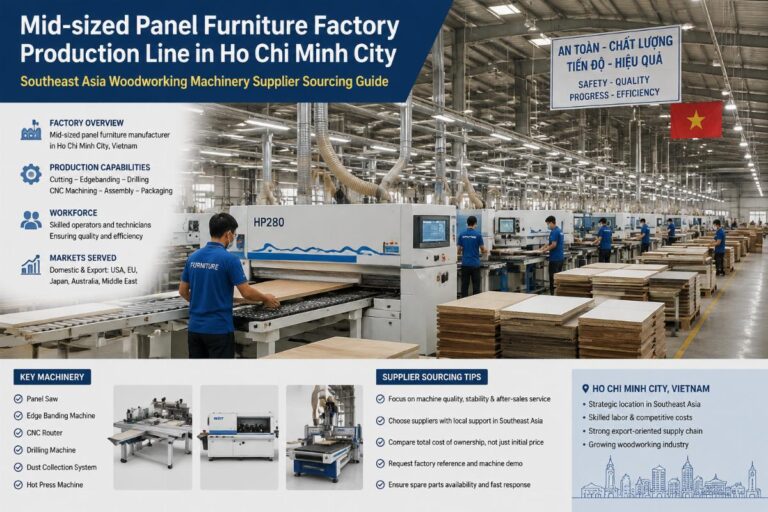
Complete Panel Furniture Line Manufacturer for Tanzania Investor
Buying a used European edge bander for your Tanzanian factory is not a bargain — it is a countdown to failure.
The single biggest reason new panel furniture lines in Tanzania stall within their first year is not poor operator skill or weak demand — it is selecting machinery that cannot survive tropical heat, voltage instability, and humidity without local supplier support. A complete panel furniture production line must be engineered for the environment it will run in, not just for the spec sheet it ships with.
I still remember standing in a Lagos cabinet workshop, watching a Nigerian owner stare at a wall of melamine boards with visible glue lines running along every edge. He had purchased a second-hand German edge bander, convinced he was getting premium quality at a fraction of the cost. Within weeks, the PUR glue pot — already aged from years of European use — could not maintain consistent melt temperature in the tropical humidity. The pre-milling unit had excessive play in the tool holder. Rework rates climbed to a point where the entire line had to shut down for weeks. That was not a machinery problem. That was a mismatch problem. [NEED_CITE: failure root causes in tropical woodworking environments per industry field reports]
When I spec a complete panel furniture production line for an East African buyer today, the first question I ask is never about cutting speed or spindle power. It is about voltage stability at the factory site, ambient humidity levels, and whether the supplier has dispatched engineers to the region before.
Let me walk you through what actually matters.
Why Do So Many New Furniture Lines in Tanzania Fail in the First Year?
The majority of first-year production line failures in Tanzania trace back to two overlooked factors: climate incompatibility and absent after-sales infrastructure.
Tanzania’s coastal regions, including Dar es Salaam, experience relative humidity levels that regularly exceed thresholds where untreated cast iron components begin surface oxidation within weeks. [NEED_CITE: tropical climate impact on industrial machinery corrosion rates in Sub-Saharan Africa] inland areas face their own challenges with dust infiltration during dry seasons. The machinery that works flawlessly in a climate-controlled German factory begins behaving differently the moment it lands at the Port of Dar es Salaam.
I have seen complete panel furniture production line installations where the electronic control panels failed repeatedly because the PLC units were not rated for the voltage fluctuation range common in Tanzanian industrial zones. The local power grid can swing well beyond the narrow tolerance bands that European-spec machines expect. Each voltage dip triggers a fault code. Each fault code stops production. The factory manager calls the supplier in Europe, waits days for a response, and watches orders pile up.
Then there is the spare parts problem. A machine sitting idle because a single sensor has failed is not a minor inconvenience — it is a financial hemorrhage. When your supplier is a trading company with no stock in the region, you are looking at weeks of downtime. I have watched startup furniture businesses burn through their working capital not because their products were bad, but because their production line was down for an extended period waiting for a replacement part that should have cost a fraction of the lost revenue.
A Middle East furniture investor once told me something that stuck: "I did not lose money on the machines. I lost money on the months they did not run."
What Are the Must-Have Specs for a Panel Line in a Tropical Climate?
A complete panel furniture production line destined for Tanzania must include wide-voltage electrical compatibility, tropical-grade corrosion protection, and PUR-capable edge banding technology as baseline requirements — not optional upgrades.
Here is how the critical specifications break down when you compare what a standard European export machine offers versus what a tropical-adapted machine should deliver:
| Specification Area | Standard European Export | Tropical-Adapted Configuration |
|---|---|---|
| Voltage Tolerance | Narrow band, single region | Wide-range adaptation across common African industrial voltages |
| Frame Construction | Standard steel welding | Heavy-duty cast iron frames for long-term rigidity and corrosion resistance |
| Edge Banding Glue System | EVA-only, basic glue pot | PUR hot-melt capable with sealed glue pot design for humidity resistance |
| PLC Control Panel | Single language, standard voltage input | Multilingual interface with wide-voltage power supply built in |
| Core Component Precision | Standard machining tolerance | CNC-machined to tight precision for sustained accuracy over extended service life |
| Pre-Shipment Testing | Sample-based | Full functional testing on every unit before dispatch |
[NEED_CITE: industrial machinery voltage compatibility standards for African markets]
Let me explain why each of these matters in practice.
Voltage adaptation is non-negotiable. Tanzanian industrial power supplies are not consistent. A complete panel furniture production line with fixed-voltage motors and control boards will trip fault codes during routine voltage fluctuations. Machines configured with wide-range power inputs — capable of handling the full spectrum of voltage variation found across African industrial zones — simply keep running. Adding external voltage stabilizers is a band-aid; the machine itself needs to be built for the reality of the grid.
PUR edge banding technology deserves special attention. In high-humidity environments, traditional EVA hot-melt adhesive absorbs moisture over time, leading to bond failure at the edge band interface. PUR reactive hot-melt adhesive, once cured, forms a moisture-resistant chemical bond that holds up in tropical conditions. [NEED_CITE: PUR vs EVA adhesive bond durability in high-humidity woodworking applications] I have inspected factories where EVA-bonded edge bands began peeling within months in coastal Tanzanian conditions, while PUR-bonded panels from the same production batch showed no degradation. The glue system is not a place to cut costs.
Heavy-duty cast iron frames are not about weight — they are about dimensional stability over time. A welded steel frame can shift subtly under thermal cycling and humidity changes, throwing off the precision of cutting and drilling operations. Cast iron, properly treated, maintains its geometry for extended service life. A complete panel furniture production line built on a rigid cast iron foundation will hold its calibration far longer than one built on a lighter frame, regardless of what the initial accuracy test shows.
How to Build a Balanced Production Line: Cutting, Edge Banding, and Drilling?
The efficiency of a complete panel furniture production line is determined not by the fastest single machine, but by the throughput balance across cutting, edge banding, and drilling stations.
Most first-time buyers make the same mistake: they invest heavily in a high-speed CNC nesting machine and then pair it with a basic semi-automatic edge bander and a manual drilling setup. The result is predictable. The cutting station produces panels faster than the edge bander can process them. Panels stack up on the floor. The edge banding station becomes the bottleneck. The drilling station falls further behind. The entire line’s output is capped by its slowest link.
Here is the sequencing logic I apply when configuring a complete panel furniture production line:
Step 1: Determine daily panel output target. Work backward from your market commitments. A wardrobe factory producing cabinets for the Dar es Salaam residential market needs a fundamentally different throughput profile than a contract furniture supplier producing for hotel projects across East Africa.
Step 2: Match the cutting station to the target. A CNC nesting machining center with an automatic tool changer and vacuum table can process multiple sheet sizes without manual intervention. For higher-volume operations, a computer-controlled beam saw delivers straight-line cutting speed that nesting cannot match. The choice depends on your product mix — custom one-off pieces favor nesting; batch production of repeated panel sizes favors beam saws. [NEED_CITE: production throughput comparison between CNC nesting and beam saw cutting in panel furniture manufacturing]
Step 3: Size the edge banding station to absorb cutting output. This is where most lines fail. The edge bander must process panels at a rate that matches or exceeds the cutting station’s output. A fully automatic straight-line edge bander with pre-milling, gluing, end trimming, flush trimming, and buffing stations running at production speeds is the minimum for a line that is meant to scale. If your cutting station outputs panels at a rate that exceeds a single edge bander’s capacity, you need either a faster edge bander or a parallel edge banding station.
Step 4: Configure drilling to close the loop. Multi-spindle boring machines with multiple row configurations handle the hinge holes, shelf pin holes, dowel holes, and cam lock holes that panel furniture requires. A six-row multi-boring machine can process both sides of a panel in a single pass, dramatically reducing cycle time compared to single-row setups. The drilling station must be positioned to receive edge-banded panels without creating a queue.
I once reviewed a complete panel furniture production line configuration for a startup in East Africa where the buyer had selected a top-tier cutting center but paired it with an entry-level edge bander. The throughput gap was so large that the cutting station would have been idle for the majority of each shift, waiting for the edge bander to catch up. The capital invested in the cutting center was essentially wasted capacity. Rebalancing the line — investing more in edge banding and drilling — would have produced a higher overall output at a lower total cost.
How to Verify a Chinese Machinery Supplier Before You Pay?
Before committing to a complete panel furniture production line purchase, verify the supplier through factory documentation, existing customer references in your region, and concrete after-sales commitments — not through marketing brochures.
The Chinese woodworking machinery market is vast, and the gap between a factory-direct manufacturer and a trading company posing as one is not always visible from a website. I have spent years visiting manufacturing facilities in Shandong Province, and I can tell you that the differences become obvious when you know what to look for.
First, demand a live factory tour via video call — not a pre-recorded video. Ask to see the assembly floor, the machining center where frame components are processed, and the testing area where machines are run before shipment. A manufacturer with integrated production will show you raw cast iron frames being machined, electronic components being assembled, and machines running through test cycles. A trading company will struggle to show you real production activity because they do not control it. [NEED_CITE: verification methods for distinguishing manufacturing from trading companies in Chinese woodworking machinery sector]
Second, request contact information for existing customers in East Africa or similar markets. A supplier who has been exporting to the region for an extended period will have references. Ask those references specifically about after-sales response time, spare parts availability, and whether the machine performed as expected after the first year of operation. A complete panel furniture production line is a significant capital commitment — you deserve to speak with someone who has already made that commitment and lived with the results.
Third, evaluate the supplier’s after-sales structure with the same rigor you apply to machine specifications. Ask these specific questions:
- Do you provide multilingual PLC interfaces, including English and French for the East African market?
- Can you supply video-guided installation and commissioning support?
- What is your spare parts supply commitment — do you maintain stock for machines you sold years ago?
- Have you dispatched engineers to Tanzania or neighboring countries for on-site installation?
- What is your warranty structure, and does it include lifetime spare parts availability?
A supplier who answers these questions with specific, verifiable commitments — rather than vague assurances — is demonstrating the kind of long-term partnership orientation that a complete panel furniture production line purchase requires.
I have worked with factory owners who received multilingual PLC panels and video-guided commissioning support that reduced their installation and training timeline dramatically. I have also worked with owners who purchased from suppliers who disappeared after the container was loaded, leaving them to troubleshoot complex CNC systems with nothing but a PDF manual in a language their operators could not read. The difference between these two experiences is not the machine — it is the supplier.
Conclusion
A complete panel furniture production line in Tanzania succeeds or fails based on environmental adaptation, throughput balance, and supplier reliability — not on brand prestige or parameter sheets. Select machinery built for tropical voltage, humidity, and dust. Balance your cutting, edge banding, and drilling capacity so no single station bottlenecks the line. And verify your supplier through real references and concrete after-sales commitments before you sign anything.