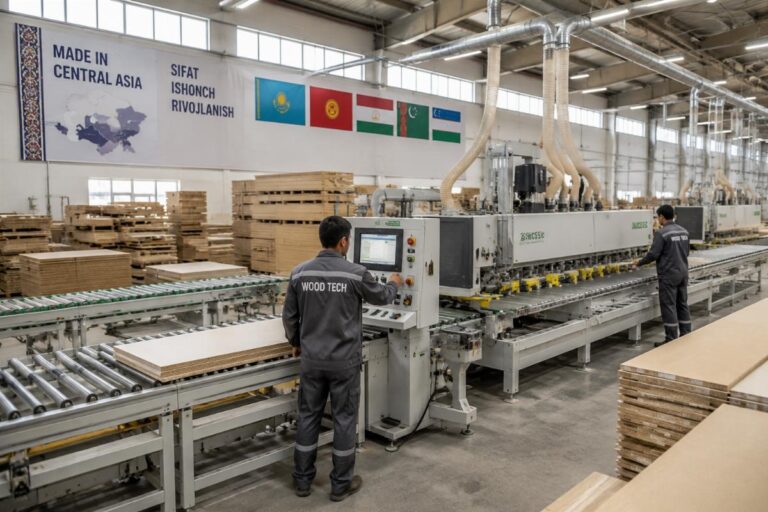
Edge Banding Machine OEM Manufacturer for Panel Furniture Production Lines
Most buyers think OEM means slapping a logo on a catalog machine. The real gatekeeping happens in PLC language switching, voltage adaptation, and frame metallurgy—details that decide whether your line runs or sits idle for weeks.
For panel furniture factory owners and regional distributors sourcing a furniture machine for OEM buyers, the non-negotiable checklist starts with voltage range compatibility from 110V to 440V, multilingual PLC interfaces covering English, Spanish, French, and Arabic, and pre-shipment testing on every single unit before it leaves the factory floor.
I still remember a cabinet factory project in Riyadh where three fully automatic edge banding lines arrived on schedule. The client hired a local electrician who bypassed the voltage stabilizer recommendation. Within days, two PLC boards burned out and the glue pot temperature control drifted wildly. The entire line was down for weeks while replacement parts crossed customs. [NEED_CITE: voltage fluctuation damage patterns in industrial PLC systems per IEC 61131-2] That kind of failure does not show up in a brochure spec sheet. It only surfaces when you verify whether the furniture machine for OEM buyers you are evaluating actually builds voltage adaptation into the hardware design rather than treating it as an afterthought.
Once you internalize that customization depth matters more than the sticker price, the next step is comparing actual machine specifications across categories to match your production reality.
What Customization Options Should OEM Buyers Prioritize?
Voltage adaptation, multilingual PLC interfaces, and private-label branding are baseline requirements, not premium add-ons that cost extra negotiation rounds.
When you approach a furniture machine for OEM buyers, the first technical conversation should cover electrical compatibility. Facilities across the Middle East, Africa, and Latin America operate on grids where voltage swings between 110V and 440V are routine. A machine wired for a single fixed voltage without a built-in transformer or stabilization interface becomes a liability the moment it hits the shop floor. [NEED_CITE: industrial machinery voltage tolerance standards per IEC 60204-1]
The second layer is the PLC control panel. Operators in Saudi Arabia need Arabic. Distributors in Colombia need Spanish. Workshops in Vietnam need Vietnamese or at minimum English. A furniture machine for OEM buyers that ships with a hardcoded Chinese-only interface creates a training bottleneck that delays production startup by weeks. The serious manufacturers build multilingual firmware switching into the base software package.
The third layer is physical branding. Logo placement on the machine housing, custom packaging design, and localized documentation in the buyer’s language are all part of the OEM package. These are not cosmetic requests—they determine whether your end customers perceive the equipment as a credible local brand or a generic import.
A distributor in West Africa started with a single semi-automatic edge bander as a trial order. Once the voltage adaptation and French-language PLC proved reliable on site, the next order expanded to a full container of mixed models. That progression only works when the furniture machine for OEM buyers supplier treats customization as standard procedure rather than a special request. [NEED_CITE: OEM customization adoption rates in woodworking machinery export markets]
How Do You Compare Core Specs Across Furniture Machine Categories?
A structured specification matrix covering edge banders, CNC routers, and boring machines reveals whether a supplier’s range actually matches your production mix or just looks broad on paper.
The furniture machine for OEM buyers market spans dozens of machine types, but most panel furniture operations revolve around three core categories. Comparing them side by side prevents the common mistake of over-specifying one machine while under-specifying another, which creates bottlenecks in the production flow.
| Category | Key Specification | Entry-Level Range | Production-Grade Range | OEM Customization Depth |
|---|---|---|---|---|
| Edge Banding Machines | Feed speed | Moderate speed suitable for startups | High-speed range reaching twenty meters per minute with pre-milling and PUR capability | Full |
| CNC Routers | Axis configuration and tool changing | Three-axis with manual tool change | Four-axis and five-axis with automatic tool changers and vacuum tables | Full |
| Wood Boring Machines | Spindle configuration | Single-row basic drilling | Multi-row configurations with twenty-three to twenty-seven spindles | Standard |
| Panel Saw Machines | Cutting format | Sliding table saw for single panels | Beam saw and panel saw for batch processing | Standard |
| Sanders and Presses | Working width and pressure | Narrow-belt sanders for small workshops | Wide-belt sanders and membrane presses for industrial volume | Basic |
[NEED_CITE: woodworking machinery specification classification per ISO woodworking equipment standards]
A startup cabinet workshop in Southeast Asia initially requested a high-speed edge bander with pre-milling and PUR gluing. After reviewing their actual daily panel volume, the right fit was a mid-range model that matched their throughput without creating idle capacity. The CNC router selection followed the same logic—a three-axis model with ATC covered their door panel engraving needs without the cost premium of a five-axis center they would not utilize.
The furniture machine for OEM buyers supplier that can walk you through this matching process across their full SKU range demonstrates engineering competence, not just sales eagerness. When the supplier covers edge banding machines, panel machinery, CNC routers, boring machines, saws, sanders, presses, and complete turnkey lines under one roof, the cross-category comparison becomes a single conversation instead of seven separate sourcing efforts.
What Quality Verification Steps Prevent Costly On-Site Failures?
Pre-shipment testing on every unit, cast iron frame inspection, and a lifetime spare parts commitment are the three verification pillars that separate serious manufacturers from trading middlemen.
The Riyadh project taught me that quality verification cannot rely on factory tour photos or ISO certificates alone. The furniture machine for OEM buyers you select must demonstrate a documented testing protocol that runs before any machine leaves the production facility.
The first pillar is full-machine testing. Every edge bander, every CNC router, every boring machine should undergo a complete operational cycle with actual workpiece material before packing. This catches wiring errors, pneumatic leaks, and calibration drifts that static inspection misses. [NEED_CITE: pre-shipment testing protocols in machinery manufacturing per ISO 9001:2015 clause requirements]
The second pillar is frame construction verification. Heavy-duty cast iron frames maintain geometric accuracy over extended service life. Welded steel frames are lighter and cheaper but gradually lose alignment under continuous vibration, leading to edge banding quality degradation that operators blame on the consumables rather than the machine structure. A furniture machine for OEM buyers built on a proper cast iron base delivers consistent precision for a decade or more. [NEED_CITE: machine tool frame material impact on long-term geometric accuracy per manufacturing engineering research]
The third pillar is spare parts availability. A twelve-month warranty means nothing if the replacement parts warehouse is empty three years later. The credible furniture machine for OEM buyers supplier commits to lifetime spare parts supply and backs it with documented inventory rather than verbal promises.
An African distributor learned this lesson when a competitor’s trading company disappeared after the warranty expired. No spare parts, no technical support, no response. The distributor switched to a factory-direct furniture machine for OEM buyers supplier with verifiable after-sales infrastructure and has not had a single line down for lack of a replacement component since.
How Should Buyers Structure MOQ, Lead Time, and After-Sales Terms?
Flexible minimum order quantities starting from a single unit, standard lead times in the range of twenty-five to forty-five days, and a twelve-month warranty with remote diagnostics form the realistic procurement framework for furniture machinery.
The furniture machine for OEM buyers procurement process should not force you into an all-or-nothing commitment. A startup workshop needs one edge bander and one CNC router to begin. A regional distributor needs a full container of mixed models. A factory upgrading to automation needs an entire production line with installation support. The supplier’s MOQ structure should accommodate all three scenarios without penalty pricing on small orders.
Lead time predictability matters as much as the lead time itself. A standard production cycle allows the buyer to plan container booking, customs clearance, and installation scheduling. Unexpected delays cascade into missed production deadlines and idle operator costs. [NEED_CITE: supply chain lead time variability impact on manufacturing project scheduling]
The after-sales framework should include remote video installation guidance as a baseline, with on-site engineer dispatch available for complex turnkey line installations. A furniture machine for OEM buyers supplier that provides multilingual technical support eliminates the language barrier that turns minor setup issues into extended downtime.
A Middle East door manufacturer structured their procurement in three phases: initial single-machine trial, followed by a partial line expansion, and finally a complete kitchen cabinet production line. Each phase used the same furniture machine for OEM buyers supplier, which meant consistent electrical standards, compatible PLC interfaces, and unified spare parts inventory across the entire facility.
Why Does Factory-Direct Pricing Matter for Long-Term ROI?
The cost advantage of sourcing a furniture machine for OEM buyers directly from the manufacturer only translates into real savings when precision tolerances and frame durability are independently verified.
Factory-direct pricing typically runs substantially below European and Italian brand equivalents. But that percentage difference means nothing if the machine loses calibration within a few years or if the frame structure cannot sustain production loads. The furniture machine for OEM buyers buyer must verify two things independently: core component machining precision and frame material specification.
Precision on critical components like guide rails, spindle housings, and pressing beams should be held to tight tolerances achieved through CNC machining rather than manual adjustment. This is what maintains edge banding quality and drilling accuracy over thousands of production cycles. [NEED_CITE: CNC machining precision impact on woodworking machinery performance consistency]
Frame durability depends on material selection. Cast iron frames resist vibration and maintain alignment. Thin-gauge welded frames flex under load and gradually distort, transferring stress to precision components and accelerating wear. The furniture machine for OEM buyers built on a proper cast iron base costs marginally more upfront but eliminates the hidden cost of premature accuracy loss.
A panel furniture factory in Latin America compared two furniture machine for OEM buyers quotations. One was cheaper on paper but used a welded frame and self-reported precision claims. The other carried a modest premium but offered verifiable CNC machining tolerances and cast iron construction. Three years later, the first machine required complete realignment and component replacement. The second machine continued running within original specifications. The total cost of ownership told a very different story than the initial invoice.
Conclusion
Sourcing a furniture machine for OEM buyers succeeds when you prioritize voltage adaptation, multilingual PLC controls, pre-shipment testing, and cast iron frame construction over the lowest initial price tag. The procurement framework should offer flexible MOQ, predictable lead times, and lifetime spare parts support. Factory-direct pricing delivers real ROI only when precision and durability are independently verified rather than taken on trust.