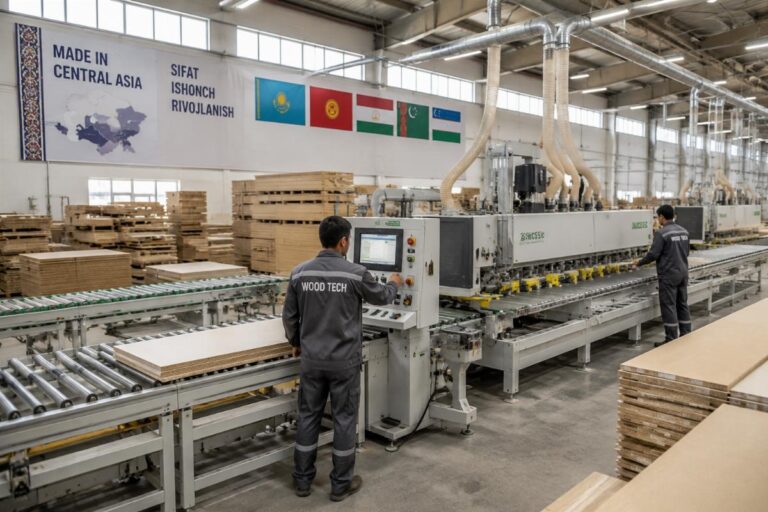
Bathroom Cabinet Production Line: Complete Turnkey Package Supplier
Buying individual machines from different vendors and bolting them together does not create a production line—it creates a maintenance nightmare. A true bathroom cabinet production line is an engineered system where every station, from the first cut to the final carton seal, talks to the next one in rhythm, voltage, and logic.
Sourcing a complete bathroom cabinet production line means procuring a synchronized workflow—covering CNC nesting, edge banding, multi-boring, assembly, and packaging—where cycle-time balance, voltage adaptation, and on-site commissioning matter far more than the brand name on any single machine.
I spent a long stretch inside a cabinet workshop on the outskirts of Riyadh, watching a brand-new automatic edge bander sit idle while the local electrician opened the control panel for the third time. The PUR hot-melt pot refused to reach working temperature. The machine was wired correctly; the problem was the factory’s industrial supply. Voltage in that industrial zone swung hard enough to starve the heating elements, and the stock heater rods shipped with the machine simply did not have the thermal reserve to cope. We ended up swapping to oversized rods and adding a local stabilization cabinet before the line ever produced a sellable carcass. That kind of headache does not show up on a spec sheet, yet it is the single most common reason a bathroom cabinet production line fails to start on schedule in emerging markets [NEED_CITE: typical industrial voltage fluctuation ranges in MENA and Sub-Saharan grid zones].
If you are evaluating a bathroom cabinet production line right now, the equipment list is only the opening chapter. The real questions are whether the stations can keep pace with each other, whether your plant’s utilities can feed them, and whether the supplier will stand beside you until the first good cabinet rolls off the end of the line.
What Equipment Does a Complete Bathroom Cabinet Line Include?
A functional bathroom cabinet production line is organized around seven sequential stations, each sized to the next one’s throughput rather than to the factory’s peak ambition.
Most buyers new to panel furniture automation assume the line starts and ends with the CNC router. In practice, the router is only the second station. The full sequence looks like this:
| Station | Core Machine | Key Selection Parameter |
|---|---|---|
| 1. Storage & Panel Loading | Automatic panel lifter / storage tower | Panel size range, magazine capacity |
| 2. Cutting & Nesting | CNC nesting center or beam saw | Spindle power, vacuum zone count, tool-change time |
| 3. Edge Banding | Automatic edge bander (pre-mill, glue, trim, buff) | Feed speed range, PUR vs EVA compatibility, minimum workpiece length |
| 4. Drilling & Grooving | Multi-spindle boring machine or CNC point-to-point | Spindle count, horizontal vs vertical ratio, CNC axis count |
| 5. Surface Finishing | Wide-belt sander or membrane press | Belt width, grit sequence, press tonnage |
| 6. Assembly & Hardware Insertion | Hinge drilling, dowel insertion, manual or semi-auto assembly jigs | Jig flexibility for bathroom cabinet SKUs |
| 7. Packaging & Palletizing | Carton erector, shrink wrapper, stretch hood | Carton size range, cycle time per box |
Leaving any station underspecified creates a bottleneck that no amount of overtime can fix. I have seen factories where the CNC nesting center could output panels fast enough to feed two edge banders, yet the boring machine was a six-row manual-feed unit that could only keep up with one. The result was a growing pile of edged panels waiting for holes, and the bathroom cabinet production line was effectively governed by its slowest link [NEED_CITE: bottleneck theory in flow-line manufacturing per operations research standards].
A Middle Eastern distributor once ordered a bathroom cabinet production line with top-spec nesting and edge banding but specified a basic semi-automatic wrapper at the packaging end. Within weeks, cartons were backing up faster than the wrapper could seal them, and workers started hand-taping boxes to keep the line moving—defeating the entire automation investment.
The right configuration depends on your daily output target, panel material mix (MDF, particleboard, melamine-faced board, or plywood for humid bathroom environments), and the degree of customization your SKUs demand. A supplier worth working with will ask about your product drawings before quoting machine models, because a bathroom cabinet production line designed for standard rectangular carcasses looks very different from one built for curved-front vanity units.
How to Balance Cycle Time Across the Entire Line?
The rated speed printed on each machine’s nameplate is almost meaningless if the stations cannot be synchronized into a single continuous flow.
Cycle-time balancing is the discipline of matching each station’s output so that no machine waits for the previous one and no buffer pile grows between them. In a bathroom cabinet production line, the typical trap is to over-invest in the "hero" machine—usually the CNC nesting center—while treating downstream stations as afterthoughts.
The method is straightforward in principle:
- Calculate the required panel throughput per shift based on your daily cabinet target and panel-per-cabinet ratio.
- Determine the effective cycle time of each station, including loading, machining, unloading, and any tool-change or edge-spool-change downtime.
- Identify the slowest station—that is your line’s true capacity.
- Either upgrade the bottleneck station or introduce controlled buffer storage before it to decouple upstream and downstream rhythms.
In a West African startup factory, the first bathroom cabinet production line was designed around a high-speed nesting center running at a feed rate the local team had never seen before. The edge bander, however, needed frequent edge-band spool changes because the factory ran six different ABS colors in a single shift. Every spool change stopped the edge bander, panels backed up between the two machines, and the nesting center was forced to idle. The line’s real output was a fraction of what the nameplate math promised [NEED_CITE: line balancing efficiency loss in mixed-model assembly environments].
The fix was not a faster edge bander. It was reorganizing the production schedule to group panels by edge color and adding a small roller-buffer between nesting and edge banding so the nesting center could keep cutting while the edge bander changed spools. That single scheduling change, combined with a modest physical buffer, lifted daily output noticeably without spending another dollar on hardware.
| Balancing Approach | Buffer Investment | Flexibility | Typical Result |
|---|---|---|---|
| Oversize the bottleneck machine | High | Low (still single-point risk) | Marginal gain, high capex |
| Add controlled buffer storage | Low to moderate | High | Noticeably smoother flow |
| Re-sequence production batches | None | High | Substantially extended effective uptime |
When you evaluate a bathroom cabinet production line proposal, ask the supplier for a cycle-time simulation based on your actual product mix, not a brochure calculation using the fastest possible panel.
What Site Conditions Must Be Verified Before Installation?
A bathroom cabinet production line is only as reliable as the utilities feeding it—voltage stability, compressed-air quality, floor flatness, and ambient humidity all dictate whether the machines run or sit idle.
Before signing a purchase order, a site-conditions audit should be completed. Skipping this step is the single most expensive mistake I see in overseas installations.
Voltage and frequency. Machines shipped to one region may face supply conditions very different from their default configuration. Industrial grids in parts of Africa, the Middle East, and Southeast Asia can swing well outside the tolerance that standard European-spec control boards expect. The fix is not just a transformer; it often requires oversized heating elements, dedicated stabilization cabinets, and sometimes a soft-start system on large spindle motors to avoid dragging down the local grid at start-up [NEED_CITE: industrial voltage tolerance standards per IEC equipment classification].
Compressed air. Pneumatic cylinders and valves on edge banders and boring machines need clean, dry air at stable pressure. In humid coastal locations, an undersized air dryer lets moisture reach the pneumatics, corroding valves and contaminating PUR glue systems. Specify an air treatment package matched to your local dew-point conditions, not a generic catalog recommendation.
Floor flatness and foundation. Heavy CNC machines and long edge banders require flat, vibration-damped floors. A floor that is nominally "level" to the naked eye can still cause registration drift on a nesting center if the tolerance is loose over the machine’s full travel. Core drilling for anchor bolts must avoid underground utilities, and the concrete cure time must be respected before the machine is leveled.
Ambient temperature and humidity. Bathroom cabinet production often involves melamine-faced boards and PVC-wrapped components that expand and contract with humidity. An unclimatized workshop in a tropical climate will see panel dimensions drift across the day, affecting edge-band trim quality and drilling accuracy.
A Southeast Asian OEM dealer once received a bathroom cabinet production line in a coastal facility where the workshop had no climate control. During the monsoon months, moisture-related edge-band adhesion failures spiked, and the PUR edge bander’s glue pot struggled to maintain stable viscosity. The machines were not defective; the environment was incompatible with the process. Adding industrial dehumidifiers and insulating the glue-pot housing resolved the issue, but the cost and delay could have been avoided with a proper site audit before shipment.
How to Evaluate a Turnkey Supplier’s Capability?
The true measure of a bathroom cabinet production line supplier is not the brochure—it is what happens after the last container clears your factory gate.
A turnkey supplier should own the entire delivery chain: factory assembly, pre-shipment testing, shipping documentation, on-site installation, commissioning, operator training, and spare-parts logistics. If any of these links is outsourced to an entity the supplier does not control, you will feel the gap the moment something goes wrong at start-up.
Here is what to look for:
Factory acceptance testing. Every machine in the bathroom cabinet production line should be assembled and run in the supplier’s own facility before disassembly for shipping. This is not a formality—it catches wiring errors, pneumatic leaks, and software mismatches that are exponentially more expensive to fix on your floor than in the builder’s hall. Ask for video evidence of the test run using your actual panel material and edge-band samples if possible.
Control-system localization. PLC panels and touchscreens should be available in the languages your operators actually read. A bathroom cabinet production line shipped to an Arabic-speaking market with a Chinese-only interface will depend permanently on one bilingual technician—who will eventually leave or become unavailable. Multilingual HMI options are not a luxury; they are an operational necessity [NEED_CITE: human-machine interface localization best practices in industrial equipment exports].
On-site commissioning and training. The supplier should dispatch field engineers who stay until the line reaches agreed performance benchmarks, not just until the machines are plugged in. Training should cover daily operation, first-line maintenance, edge-band and tooling changes, and basic fault diagnosis—not just a one-day walkthrough.
Spare-parts availability. Critical wear parts—trimming blades, buffing wheels, glue pots, drill bits, vacuum pods—should be available from the supplier with predictable lead times. A bathroom cabinet production line that cannot get a replacement trimming blade within a reasonable window is a line that will run at reduced quality or stop entirely.
| Evaluation Dimension | Basic Supplier | Capable Turnkey Partner |
|---|---|---|
| Pre-shipment testing | Sample-level or self-reported | Full batch-level, video-verifiable |
| PLC language options | None or single language | Multiple languages including regional |
| On-site commissioning | Remote guidance only | Resident engineer until benchmark met |
| Spare-parts supply | Ad hoc, long lead times | Structured inventory, predictable delivery |
| Technical documentation | Machine manuals only | Line-level layout, maintenance schedules, troubleshooting guides |
I have watched buyers choose a bathroom cabinet production line based on the lowest unit price, only to spend a mid-five-figure sum on third-party service calls and air-freighted spare parts in the first year. The cheapest machine on the invoice is rarely the cheapest machine in operation.
What Are Common Pitfalls in Overseas Line Commissioning?
The majority of overseas bathroom cabinet production line failures are not mechanical—they are logistical, electrical, and communicative.
After years of walking into factories where lines have been sitting in crates for months, I have seen the same patterns repeat across regions.
Voltage mismatch discovered on day one. Machines arrive wired for one voltage standard and the local supply is different. Without the correct transformer or re-wiring, nothing runs. The fix is straightforward but requires advance knowledge—something the supplier should have confirmed before building the control panels.
Missing or incorrect spare parts in the initial shipment. A bathroom cabinet production line needs a commissioning spare-parts kit sized for the first several months of operation. If the initial container skips wear parts "to save space," the first blade failure can shut down the edge banding station for weeks while replacements cross borders.
Language and documentation gaps. Operators who cannot read the interface or maintenance manuals will default to guesswork. I have seen parameter settings changed by trial and error on a CNC nesting center, destroying an entire batch of melamine panels before someone realized the feed-rate value had been entered in the wrong unit.
Local contractor misalignment. Foundation work, electrical wiring, and air-line installation are usually done by local contractors. If they work from the machine’s default drawings rather than the site-adapted version, anchor-bolt positions can be wrong, cable cross-sections can be undersized, and air-line diameters can restrict flow to pneumatic stations. The supplier’s field engineer should review and approve all local contractor work before machines are set in place [NEED_CITE: common installation failure modes in imported industrial machinery per trade engineering guidelines].
Seasonal environmental surprises. A line commissioned in the dry season may run perfectly, only to develop adhesion and registration problems when the rains arrive. Site-condition planning must account for the full annual climate range, not just the weather on installation day.
A Latin American bathroom cabinet factory experienced all five of these issues on their first line. Voltage was wrong, spare blades were not in the container, the Spanish-language PLC manual arrived six weeks late, the local electrician had used undersized cables, and the rainy season killed PUR adhesion within weeks. The line eventually ran well—but only after a second commissioning visit, additional air-freight costs, and a retrofit dehumidification system. The total cost of those pitfalls was several times the price difference between the chosen supplier and a more experienced alternative.
Conclusion
A bathroom cabinet production line is a system, not a shopping list. Equipment configuration, cycle-time balance, site-utility readiness, supplier commissioning depth, and foresight about local pitfalls together determine whether the line produces sellable cabinets on schedule—or becomes an expensive lesson. Choose the partner who asks the hardest questions before shipping, and the machines will ask far fewer of you after they arrive.