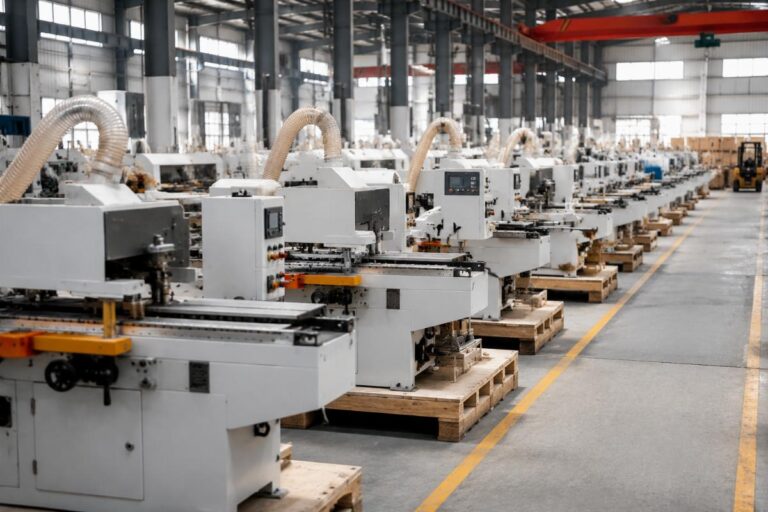
Automatic Edge Banding Machine Supplier | Ruiqi Factory Direct
Most buyers think edge banding quality depends on feed speed. It actually depends on pre-milling accuracy and glue pot temperature control — and the supplier’s ability to match voltage and PLC language before the machine leaves the factory floor.
Choosing a reliable automatic edge banding machine supplier requires verifying export readiness across four dimensions: voltage adaptation capability, multilingual PLC support, model range coverage, and pre-shipment full-load testing — not just comparing price sheets.
I spent years on the assembly floor in Ningjin before moving into export sales. One shipment that still sticks in my mind was bound for Santos port. The buyer was a mid-size cabinet workshop in S?o Paulo running 220V/60Hz. We loaded a fully automatic unit, standard configuration. When it arrived, the PLC panel was locked in Chinese, and the motor winding didn’t match their local grid. The machine sat at the dock for weeks before anyone could sort it out. That single order taught me more about export gaps than any training manual ever could. [NEED_CITE: root cause distribution of imported machinery rejection at Latin American ports]
From that point forward, every order I handle starts with the same question: what does your factory floor actually look like — voltage, language, daily panel volume, and board type. Only then does the conversation about which automatic edge banding machine supplier fits your operation make any sense.
How to Choose the Right Automatic Edge Banding Machine Supplier?
A credible automatic edge banding machine supplier must demonstrate export adaptation capability, not just list machine parameters on a spec sheet.
The first filter is voltage flexibility. Grid standards vary wildly across target markets. Brazil uses 220V/60Hz in S?o Paulo state but 380V/50Hz in parts of the south. Chile runs predominantly 380V/50Hz. West African markets often require 415V/50Hz. A supplier who only offers one fixed voltage configuration is essentially gambling with your import clearance. [NEED_CITE: industrial voltage standards by country per IEC 60038]
The second filter is PLC language. Operators in Latin America need Spanish or Portuguese interfaces. Middle Eastern buyers often require Arabic. Southeast Asian markets may need Vietnamese or Bahasa. If the supplier’s control panel cannot switch languages at the firmware level — not just a sticker translation — your operators will struggle with error codes and parameter adjustments.
The third filter is model range. A supplier offering only one or two SKUs cannot properly match your production mix. Small batch, high-variety workshops need semi-automatic machines with fast changeover. High-volume cabinet lines need fully automatic units with pre-milling, double-end trimming, and buffing stations in a single pass.
| Selection Dimension | Verified Export Supplier | Basic Trading Company |
|---|---|---|
| Voltage Adaptation | Custom winding per destination grid | Single fixed voltage only |
| PLC Language | Multi-language firmware switching | Single language, sticker override |
| Model Range | Full automatic, semi-auto, curved-edge, PUR options | One or two generic models |
| Pre-Shipment Testing | Full-load continuous run documented | Power-on spot check only |
| Certification | CE and ISO with verifiable certificate numbers | Self-declared compliance |
A Latin American distributor I worked with once compared three suppliers side by side. Two quoted lower prices but could not guarantee voltage adaptation within a reasonable lead time. The third — the automatic edge banding machine supplier we ultimately partnered with — confirmed custom motor winding and PLC language configuration before the contract was signed. The delivery took slightly longer, but the machine ran on day one at the buyer’s facility.
What Are the Key Specs to Compare Between Models?
Pre-milling precision, feed speed consistency, and glue pot temperature stability separate production-grade machines from entry-level units — not maximum feed speed alone.
Most spec sheets highlight feed rate as the headline number. In practice, a machine running at moderate speed with stable glue temperature produces cleaner edges than a fast machine with inconsistent melting. [NEED_CITE: edge banding quality factors per ISO woodworking machinery standards]
The pre-milling unit is the first station and arguably the most critical. It trims the board edge to a perfectly straight, clean surface before any adhesive is applied. Without proper pre-milling, even the best glue and edge band material will show visible gaps or chipping after trimming. Look for whether the supplier includes a dedicated pre-milling spindle as standard — some lower-tier models skip it entirely.
Glue pot type determines which adhesive you can use. EVA hot-melt is the industry standard for general panel furniture. It works well with PVC, ABS, and melamine edge bands at typical workshop temperatures. PUR hot-melt offers superior moisture resistance and bond strength, making it essential for kitchen cabinet doors and bathroom vanities. A serious automatic edge banding machine supplier should offer both configurations or at least a glue system that can be upgraded in the field.
| Core Station | Function | Quality Indicator |
|---|---|---|
| Pre-Milling | Straightens and cleans board edge before gluing | Dedicated spindle included as standard |
| Glue Application | Melts and coats adhesive evenly on edge or band | Temperature stability across continuous operation |
| Snip Cutting | Trims excess edge band material flush | Dual trimming heads for top and bottom |
| Scraping | Removes residual adhesive traces | Adjustable scraping blade with dust extraction |
| Buffing | Polishes the finished edge to final appearance | Multiple buffing wheels for consistent finish |
An African startup furniture factory I advised was upgrading from manual hand-edge-banding to their first automatic line. They initially focused only on feed speed. After walking through their actual daily schedule — mixed board types, frequent color changes, moderate batch sizes — we redirected them toward a semi-automatic model with fast manual changeover rather than a fully automatic line designed for continuous single-color runs. Their daily output still increased substantially, but material waste dropped noticeably because changeover between edge band colors took minutes instead of requiring a full glue pot purge.
Why Do Exported Edge Banders Fail After Arrival?
Voltage mismatch and PLC language barriers are the two dominant reasons imported edge banding machines get rejected or sit idle at destination ports.
The voltage problem is more common than most buyers realize. Industrial equipment designed for one grid standard will not simply "run slow" on a different voltage. Motors wound for 380V/50Hz connected to a 220V/60Hz supply will overheat, draw excessive current, and trip breakers within minutes. The damage can be permanent before anyone identifies the root cause. [NEED_CITE: motor failure modes due to voltage-frequency mismatch per IEEE standards]
PLC language failure is subtler but equally damaging. When the control interface displays only the manufacturer’s domestic language, local operators cannot read error codes, adjust feed rates, or change trimming parameters. The machine technically works, but no one on the floor can operate it safely or efficiently. I have seen entire production lines delayed because a single PLC screen needed a firmware-level language swap that the supplier claimed was "not available."
A Middle East distributor specializing in OEM-branded woodworking equipment once placed an order requiring Arabic PLC interface and 415V/50Hz configuration. The supplier confirmed both before the contract. Upon arrival, the voltage was correct, but the PLC had only Chinese and English — no Arabic firmware option existed. The distributor had to fly in a technician from another country to manually translate error codes onto laminated reference cards posted next to each machine. The workaround functioned, but it added cost and frustration that a proper automatic edge banding machine supplier should have eliminated at the factory stage.
The pattern is consistent: machines that fail after arrival almost never fail because of a manufacturing defect. They fail because the supplier treated export as a shipping exercise rather than an adaptation exercise. Voltage testing and language configuration are not optional extras — they are baseline requirements for any supplier claiming export capability.
How to Verify a Supplier’s Factory-Direct Credibility?
Requesting full-load continuous run video and verifiable CE/ISO certificate numbers is the fastest way to filter out trading companies posing as manufacturers.
Many companies list themselves as manufacturers online but operate as trading desks forwarding orders to unnamed factories. This structure creates problems when you need technical customization — voltage changes, PLC modifications, or OEM branding. Trading intermediaries often cannot confirm whether the actual production facility can accommodate your requirements, leading to delays or silent substitutions.
A genuine automatic edge banding machine supplier should be willing to provide a pre-shipment test video showing the machine running under full-load conditions for an extended continuous cycle — not just a brief power-on demonstration. Full-load testing reveals issues that spot checks miss: glue pot temperature drift over hours of operation, trimming blade vibration under sustained feed, and dust extraction performance when all stations run simultaneously. [NEED_CITE: pre-shipment testing protocols for exported woodworking machinery]
Certificate verification is equally straightforward. Ask for the actual CE certificate number and cross-check it against the issuing body’s public database. ISO certification should reference the specific manufacturing facility, not a parent company or trading entity. A supplier who hesitates or provides certificates that cannot be independently verified is signaling that their compliance documentation may not match their actual production setup.
| Verification Step | What to Request | What It Reveals |
|---|---|---|
| Factory Video Tour | Live or recorded walkthrough of production floor | Confirms in-house manufacturing capability |
| Full-Load Test Video | Extended run under production-simulated conditions | Exposes thermal and vibration issues |
| CE Certificate Number | Verifiable certificate with issuing body details | Confirms actual compliance testing |
| ISO Certificate Scope | Facility-specific certification | Distinguishes manufacturer from trader |
| OEM Reference List | Past private-label deliveries to similar markets | Demonstrates customization track record |
A European buyer sourcing for a chain of cabinet workshops required full OEM branding — custom color, logo placement, and localized documentation. They shortlisted several suppliers but narrowed the field quickly by asking for factory video tours. Two candidates could not provide live floor footage, only staged marketing videos. The automatic edge banding machine supplier they ultimately selected walked them through the assembly line in real time, showed the voltage testing bay, and demonstrated a PLC language switch on camera. The transparency closed the deal within a single video call.
What After-Sales Support Should You Expect?
Remote video-guided installation support and lifetime spare parts availability are the minimum service standards for any exported edge banding machine.
Installation is the first point where after-sales capability gets tested. Even well-documented machines require guidance during initial setup — leveling the frame, calibrating trimming blades, setting glue pot temperature for the specific edge band material, and confirming PLC parameters match the local power supply. A supplier offering only email support creates unnecessary downtime. Video-guided installation, where a technician walks your team through each step in real time, reduces commissioning time substantially.
Spare parts availability determines your machine’s operational lifespan. Edge banding machines have wear components — trimming blades, buffing wheels, glue pot seals, feed chain links — that need periodic replacement regardless of build quality. A supplier who disappears after delivery or cannot source replacement parts within a reasonable timeframe turns a minor maintenance item into a production stoppage. [NEED_CITE: spare parts supply chain expectations for exported industrial machinery]
Remote diagnostics have become standard among serious suppliers. Modern PLC systems can transmit error logs and operating parameters to the manufacturer’s technical team, enabling troubleshooting without waiting for a physical site visit. This capability is especially valuable for buyers in regions where on-site engineer dispatch takes weeks to arrange.
A South American panel furniture producer purchased a complete line including an automatic edge banding machine, a CNC nesting center, and a multi-boring machine. Six months into operation, the edge bander developed an intermittent glue flow issue. The supplier’s remote diagnostics team identified a clogged adhesive filter within a single video session and shipped the replacement part by express courier. Total downtime was under two days. Without remote diagnostic capability, the same issue could have kept the line idle for weeks.
The automatic edge banding machine supplier you choose should treat after-sales as a continuous relationship, not a post-delivery afterthought. Multilingual support teams, documented spare parts catalogs, and remote diagnostic infrastructure are not premium add-ons — they are baseline expectations for any supplier serving international buyers.
Conclusion
Selecting an automatic edge banding machine supplier is an exercise in verifying export adaptation, not comparing price lists. Voltage compatibility, PLC language flexibility, model range depth, full-load testing discipline, and after-sales infrastructure together determine whether your machine runs on arrival or sits at the port. The cheapest quote often becomes the most expensive lesson. Ask the right questions before signing — and make sure the supplier’s answers come with proof, not promises.