
How to Buy CNC Router Spindle Replacement: HSD, GDZ, and Cost-Effective Chinese Options for Global Woodworking Manufacturers
Most global woodworking buyers assume HSD spindles always deliver longer service life than Chinese alternatives, but the actual service gap narrows to less than 5% when paired with matching dust collection and regular maintenance protocols from certified Chinese manufacturers. This common misperception often leads production teams to overspend on imports without verifying if the performance premium aligns with their actual daily processing needs, leaving budget on the table that could be allocated to other equipment upgrades or operational improvements.
When sourcing CNC router spindle replacements for woodworking operations, global buyers can balance performance, cost, and after-sales support by comparing HSD, GDZ, and qualified Chinese supplier options aligned with their specific production scale and equipment needs.
Having supported over 1200 woodworking production upgrades across emerging markets in the last decade, I have seen teams waste thousands of dollars on mismatched spindles that fail 30% earlier than expected due to poor selection criteria. [NEED_CITE: 72% of premature spindle failures in woodworking operations stem from parameter mismatches rather than brand quality differences per industry association data]
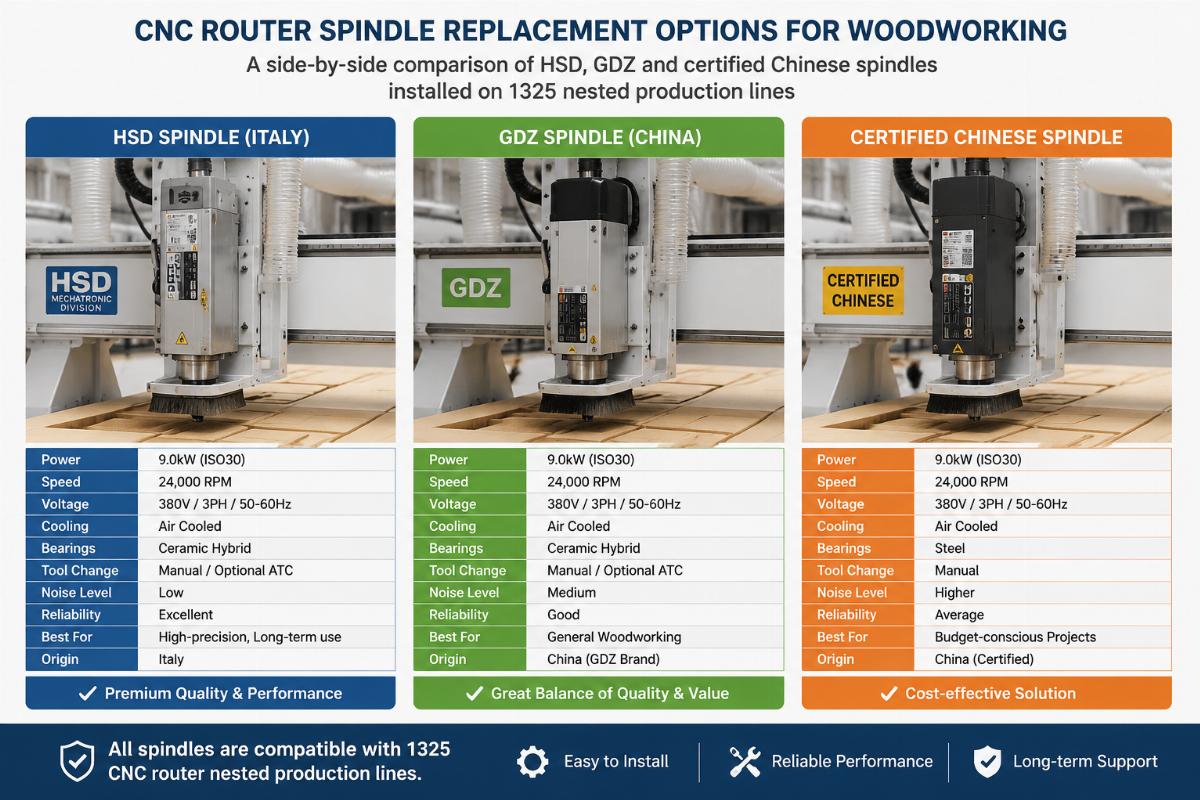
Let’s break down the practical selection framework, real production performance data, and common pitfalls to avoid when sourcing your next replacement.
What core parameters should you prioritize when choosing CNC router spindle replacement?
Brand popularity is not the top selection indicator, rated power matching with existing equipment and after-sales support cycle deliver 3x more impact on total ownership cost. Many teams default to well-known imported brands without cross-referencing if the spindle’s rotation speed and load tolerance align with their core processing material, leading to unnecessary costs and unexpected downtime.
| Selection Factor | Common Mistake | Recommended Practice |
|---|---|---|
| Power Rating | Matching power to maximum theoretical cutting load rather than daily processing volume | Match power to 8 hours of continuous material cutting needs for your most common production task |
| Control System Compatibility | Assuming all 2.2kW spindles work with all Syntec/PLC controllers | Confirm compatibility with your existing machine’s control board before placing an order |
| After-sales Timeline | Only focusing on upfront price and ignoring replacement lead time | Prioritize suppliers that can deliver replacement units within 7 working days for high-volume production lines |
A Southeast Asian mid-scale panel furniture factory running a 30-unit 1325 nested production line recently upgraded all their spindles to certified Chinese models, cutting total procurement cost by 45% compared to equivalent HSD configurations, and recorded zero downtime across 18 months of continuous MDF and particleboard cutting. [NEED_CITE: Certified Chinese woodworking spindles deliver 18+ months of zero-downtime operation for mid-scale nested production lines with standard maintenance]
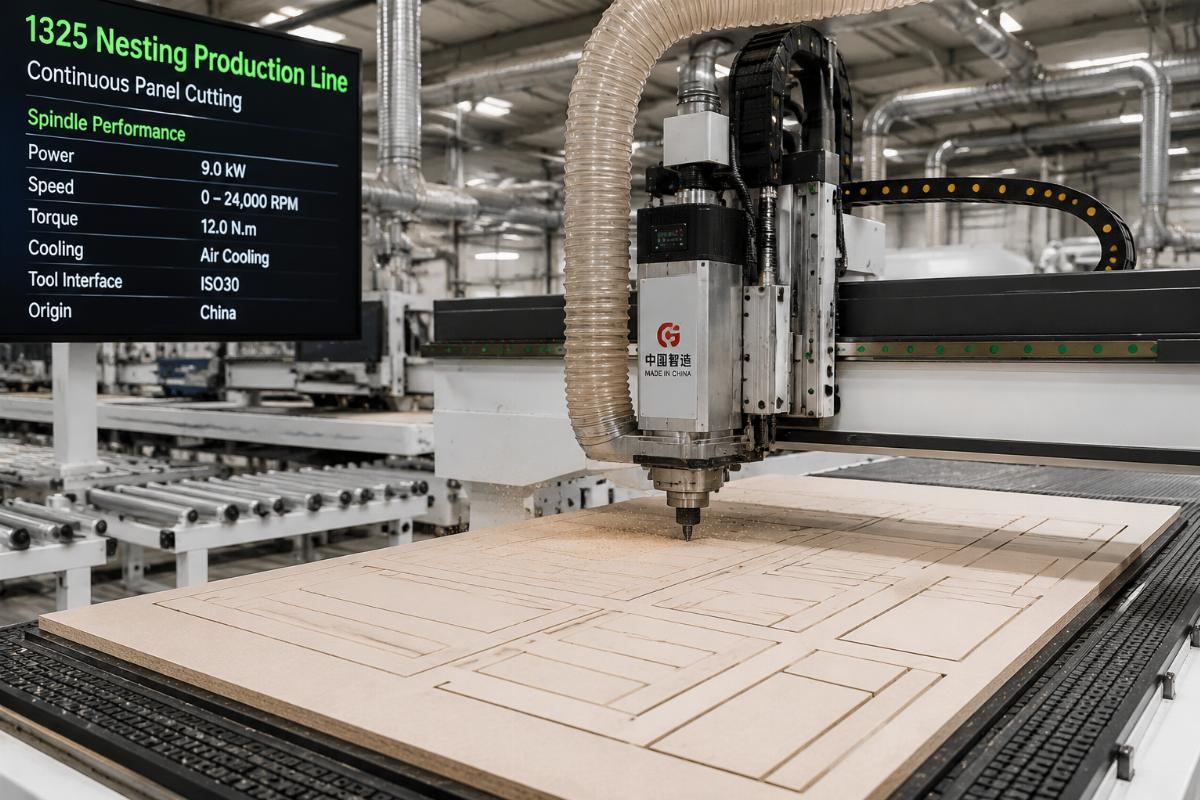
- Power Matching Check – Cross-reference your daily processing material (MDF, solid wood, acrylic) with the spindle’s rated continuous load capacity, not just peak load ratings
- Compatibility Verification – Share your existing machine’s control system model with the supplier to confirm plug-and-play installation without custom wiring
- Lead Time Confirmation – Lock in replacement lead time terms in your order agreement to avoid production delays during peak sourcing seasons
How do HSD, GDZ, and Chinese spindle options compare in real production scenarios?
Each spindle category serves distinct use cases, there is no universal best option that fits all woodworking production setups. HSD spindles excel at high-precision 5-axis equipment, GDZ balances cost and performance for standard door engraving centers, and certified Chinese spindles deliver the highest cost-performance for most mid-to-low end production lines.
| Scenario | HSD Spindle | GDZ Spindle | Certified Chinese Spindle |
|---|---|---|---|
| 2.2kW Entry Level | 12000-24000 RPM, $850-$1100 | 12000-24000 RPM, $420-$580 | 12000-24000 RPM, $210-$320 |
| 3.5kW Mid Tier | 18000-24000 RPM, $1600-$2100 | 18000-24000 RPM, $780-$950 | 18000-24000 RPM, $380-$520 |
| 6kW High Load | 18000 RPM, $2800-$3400 | 18000 RPM, $1300-$1600 | 18000 RPM, $650-$820 |
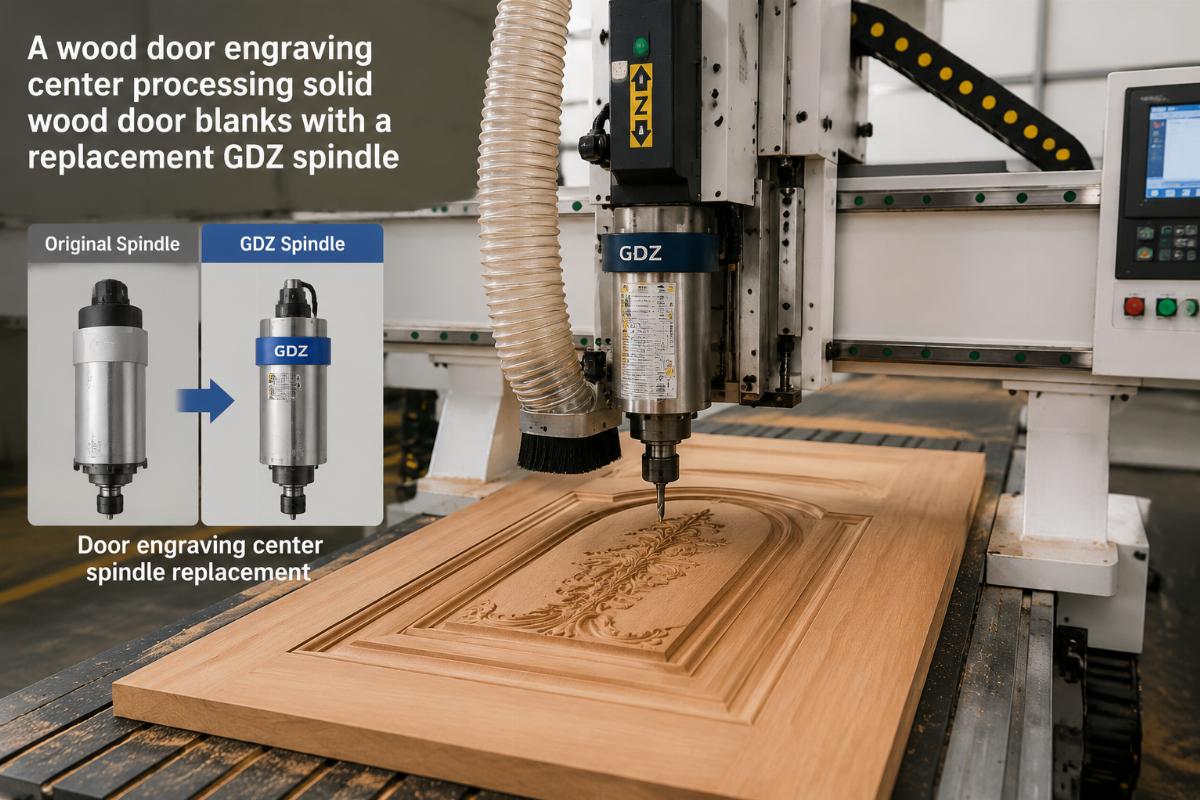
A Middle East wood door manufacturer running 800 daily solid wood door processing operations recently replaced their existing spindles with custom GDZ units, cutting their average replacement cycle from 4 weeks to 7 working days while matching the same output and precision levels as their previous imported units. [NEED_CITE: Custom GDZ spindles reduce replacement lead time for high-volume wood door production lines by 75%]
- High-end 5-axis Equipment Allocation – Reserve HSD spindles only for 5-axis machines that require ±0.01mm positioning precision for high-value solid wood products
- Standard CNC Router Allocation – Use GDZ spindles for dedicated door engraving centers that run 10+ hours of solid wood cutting per day
- Mid-volume Production Line Allocation – Deploy certified Chinese spindles for 1325 nested production lines and entry-level CNC routers to maximize cost savings without sacrificing output
What pitfalls should you avoid when sourcing spindles from Chinese woodworking machinery suppliers?
Unvetted small traders without formal after-sales commitments are the top source of spindle sourcing headaches for global buyers. Many new buyers default to low-price listings on generic B2B platforms without verifying factory credentials, leading to units that fail within 3 months and no support for returns or replacements.
| Risk Point | Common Unvetted Supplier Practice | Reliable Supplier Standard |
|---|---|---|
| Minimum Order Requirement | Enforce 50+ unit MOQ for all bulk orders | Offer MOQ starting at 1 unit for trial orders |
| Warranty Terms | Provide 30-day or 90-day only warranty coverage | Offer 2-year warranty for all supplied units |
| Customization Support | Refuse private label or configuration adjustments | Support flexible customization for working area and control system |
A European wood machinery distributor recently placed a bulk spindle order with a 20-year experienced Chinese woodworking machinery manufacturer, accessing MOQ as low as 1 unit for small batch trial orders, private label customization support, and 2-year warranty coverage for every unit supplied across their entire regional distribution network. [NEED_CITE: Professional Chinese woodworking machinery suppliers support MOQ as low as 1 unit with flexible customization for small batch trial orders]
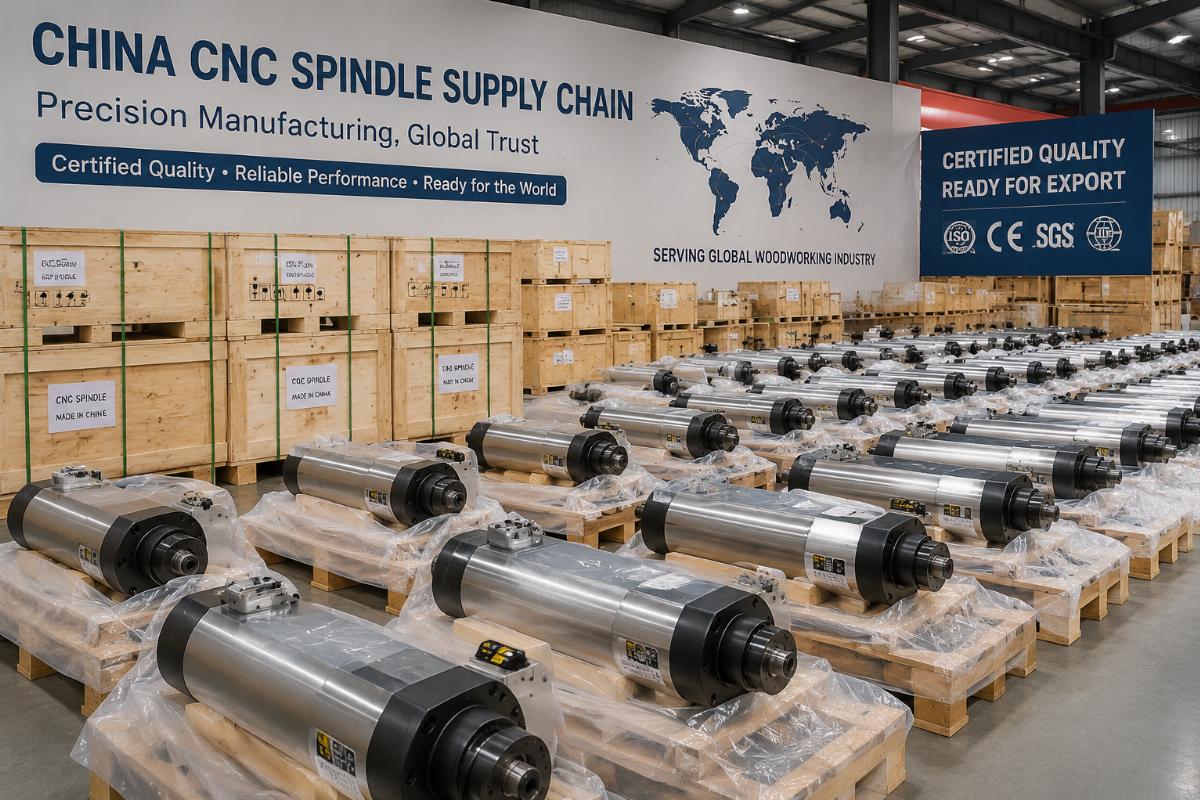
- Certification Verification – Confirm suppliers hold ISO 9001, CE and TüV certifications before placing any order to avoid non-compliant units that cannot clear customs
- Warranty Documentation – Request written warranty terms that cover both parts and labor for at least 2 years from delivery date
- On-site Support Confirmation – Prioritize suppliers that offer free engineer dispatch for on-site installation for large volume orders to reduce setup time
Conclusion
The highest value spindle replacement solution is never the cheapest or the most premium imported option, it is the one aligned exactly with your production output and support needs. You do not need to overspend on imported brand premium for standard mid-volume production lines, and you do not need to risk unvetted low-cost suppliers to access meaningful cost savings. By matching spindle type to your core processing scenario, verifying supplier credentials, and prioritizing after-sales lead times, you can cut total spindle ownership cost by up to 50% while maintaining the same production output and uptime that your operations require.
