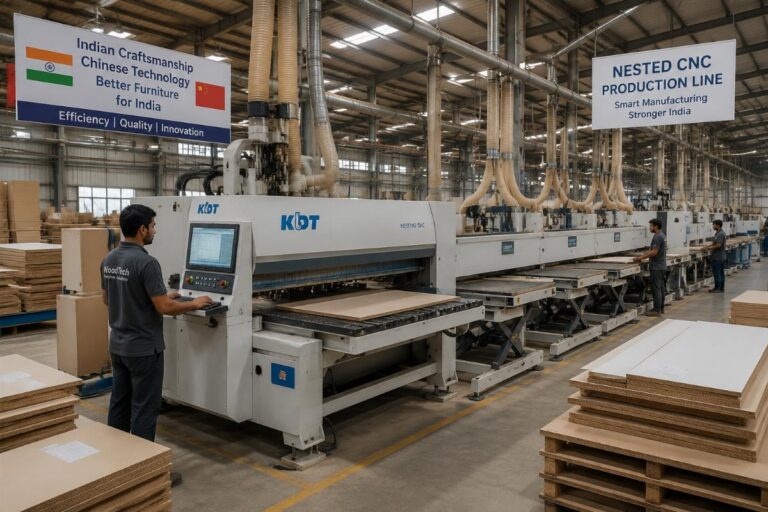
1300×2500 CNC Router for MDF Cutting | Factory Direct for Sale
Bigger spindle power does not always mean cleaner MDF cuts—mismatched RPM and feed rate will burn the tool edge within minutes.
A 1300×2500 CNC router for MDF cutting is defined by three core parameters: working area dimensions, spindle power rating, and vacuum table zone configuration. The final purchase price swings widely depending on whether you need a basic manual tool-change setup or a fully automated ATC system with multi-zone vacuum suction. Choosing the right combination prevents costly production downtime and ensures your panels stay flat during high-speed nesting.
I still remember a shipment that landed in Veracruz a few years back. The buyer ran a small cabinet workshop and had just upgraded from manual panel saws. They ordered a machine with a standard six-zone vacuum table, expecting it to hold thin MDF sheets for intricate door panel cuts. The moment they loaded 6mm boards, the panels shifted mid-cut, ruining an entire batch of melamine-faced stock. The complaint call came in hot—accusations about machine quality, demands for a replacement. What nobody checked at the quoting stage was that thin, warped MDF requires significantly more suction zones than standard 18mm cabinet stock. That single parameter mismatch turned a routine delivery into a mid-five-figure headache. [NEED_CITE: vacuum table zone requirements relative to panel thickness and material flatness per woodworking machinery standards]
Understanding how each specification translates to real workshop performance is what separates a smooth installation from months of frustration. Let me walk you through the parameters that actually matter.
What Defines a 1300×2500 CNC Router for MDF?
The working envelope, spindle type, and table structure form the foundational specification trio for any 1325-class CNC router targeting MDF processing.
The 1300×2500 mm working area has become the de facto standard for panel furniture production across multiple regions. This dimension maps almost perfectly onto standard MDF and particleboard sheet sizes, minimizing material waste during nesting. [NEED_CITE: standard panel sheet dimensions and material utilization rates in furniture manufacturing]
When evaluating a 1300×2500 CNC router for MDF cutting, buyers should focus on three structural elements:
| Parameter | Basic Configuration | Mid-Range Setup | Production-Grade Build |
|---|---|---|---|
| Frame Construction | Welded steel tube | Heavy-duty steel with stress relief | Cast iron or annealed steel gantry |
| Drive System | Stepper motors with belt drive | Hybrid servo motors | Full AC servo with helical rack |
| Control Interface | Basic DSP handle | PLC with touchscreen | Industrial PLC with multilingual support |
| Positioning Accuracy | Acceptable for rough cuts | Consistent repeat positioning | Tight tolerance maintained over extended operation |
A Southeast Asian startup furniture workshop once ordered a unit with a welded steel frame and stepper motor drive. For their initial production of simple shelf panels, it worked adequately. But when they scaled up to kitchen cabinet components requiring dowel holes and hinge bore patterns, the repeatability drifted noticeably after several months of continuous operation. The frame lacked the rigidity to maintain alignment under sustained cutting loads. [NEED_CITE: machine frame rigidity impact on long-term positioning accuracy in CNC woodworking equipment]
The control system matters more than most buyers realize. A multilingual PLC panel—supporting English, Spanish, French, or Arabic interfaces—reduces operator training time substantially, especially in regions where technical English proficiency varies. We have seen installations where a language-localized control panel cut onboarding time from weeks to days.
Which Spindle Power Fits Your MDF Thickness?
Most buyers assume maximum spindle power delivers maximum performance—the reality is that excessive power at incorrect feed rates burns tool edges and degrades cut quality on standard MDF.
The relationship between spindle power, material thickness, and cutting speed follows a specific logic that many first-time buyers overlook. Here is a practical breakdown:
| MDF Thickness | Recommended Spindle Range | Cutting Approach |
|---|---|---|
| Up to 12mm | Entry-level air-cooled spindle | Single-pass with moderate feed rate |
| 12mm to 18mm | Mid-range water-cooled spindle | Single-pass at optimized speed |
| 18mm to 25mm | High-power water-cooled spindle | Controlled multi-pass or heavy single-pass |
| Above 25mm | Maximum power spindle with compression bits | Multi-pass strategy mandatory |
A cabinet door manufacturer in the Middle East initially specified the highest available spindle power for their 1300×2500 CNC router for MDF cutting, reasoning that more power meant faster throughput. In practice, their operator ran the machine at aggressive feed rates without adjusting RPM proportionally. The result: frequent bit breakage, burnt cut edges on melamine-faced boards, and shortened tool life that drove consumable costs noticeably higher. Once they matched spindle speed to feed rate for their standard 18mm stock, cut quality improved immediately—and tool costs dropped substantially. [NEED_CITE: spindle speed and feed rate optimization for MDF routing per tooling manufacturer guidelines]
Water-cooled spindles offer a clear advantage over air-cooled units in continuous production environments. The cooling circuit maintains stable operating temperature during extended shifts, which directly translates to consistent cutting performance and longer bearing service life. For shops running single shifts on thin stock, air-cooled units remain a viable, cost-effective option.
How Many Vacuum Zones Do You Really Need?
Vacuum table zone count directly determines holding stability—six zones handle standard cabinet panels adequately, but nine zones become essential for thin sheets and small irregular components.
This is where specification sheets can mislead. A vacuum table may advertise strong suction capacity in aggregate, but if the zone layout does not match your typical workpiece size, panels will lift during cutting. The critical factor is how many independent zones the table divides into, and whether each zone can be selectively activated.
| Zone Configuration | Best Suited For | Limitation |
|---|---|---|
| Standard six-zone | Full-size 18mm cabinet panels, standard nesting | Thin or warped boards may shift at edges |
| Extended nine-zone | Thin MDF, small door components, irregular shapes | Slightly higher initial investment |
| Full-grid vacuum | Mixed-size batch production, complex nesting patterns | Premium configuration tier |
A European custom furniture workshop producing both full wardrobe side panels and small decorative drawer fronts from the same machine faced exactly this dilemma. Their six-zone table held the large panels perfectly, but when they loaded 6mm MDF for intricate drawer components, the suction distribution left the smaller pieces unstable. Adding a nine-zone configuration resolved the issue entirely. [NEED_CITE: vacuum table zone design principles for CNC router workholding in panel processing]
When requesting quotes for a 1300×2500 CNC router for MDF cutting, specifically ask the supplier to explain their vacuum zone layout relative to your planned workpiece dimensions. A responsible manufacturer will ask what panel sizes you run most frequently before recommending a zone configuration. If they simply quote the highest-suction pump without discussing zone distribution, that is a warning sign.
The vacuum pump itself also warrants attention. Dry rotary vane pumps require less maintenance than oil-lubricated alternatives, though they operate at higher noise levels. Shop location and local noise regulations should factor into this decision.
ATC Tool Changer: 8 vs 12 vs 16 Tools?
Tool magazine capacity determines how many operations your 1300×2500 CNC router for MDF cutting can complete without manual intervention—higher tool counts directly reduce cycle time on complex cabinet components.
Automatic tool changers separate entry-level CNC routers from production-grade machines. The question is not whether you need ATC, but how many tool positions your production mix actually demands.
| Tool Magazine Size | Typical Application | Tool Change Speed |
|---|---|---|
| Eight-position linear ATC | Simple panel cutting, basic drilling | Standard changeover interval |
| Twelve-position disc or linear ATC | Cabinet production with drilling and grooving | Noticeably faster batch completion |
| Sixteen-position disc ATC | Complex door panels, multi-operation components | Shortest cycle times for mixed operations |
A distributor in North Africa received a bulk order of 1325 machines from a regional furniture factory group. The factories produced kitchen cabinets requiring routing, hinge boring, dowel drilling, and groove cutting—all on the same panel. Their initial specification called for an eight-position ATC, but after reviewing their component drawings, it became clear that twelve positions were the practical minimum. Each additional tool position eliminated a manual changeover that would have added seconds per panel—seconds that multiplied across hundreds of panels per day into substantial productivity loss. [NEED_CITE: ATC tool magazine capacity impact on production throughput in panel furniture manufacturing]
The tool change mechanism itself varies in design. Linear magazine systems mount tools in a row beside the working area, offering straightforward maintenance access. Disc-type magazines position tools in a circular arrangement, often achieving slightly faster changeover cycles. Both designs perform reliably when properly maintained.
For buyers evaluating a 1300×2500 CNC router for MDF cutting with ATC, request a sample cutting cycle timed with different tool magazine sizes. Seeing the actual changeover interval on your own component program provides far more insight than any specification sheet number.
What Is the Real Cost Beyond the Machine Price?
The quoted machine price is only the starting point—voltage customization, export packaging, and after-sales response infrastructure represent significant cost factors that buyers frequently underestimate.
Every international shipment carries requirements that do not appear on the base price list. Voltage adaptation is the most common surprise. Industrial power standards vary dramatically across regions—some markets run on 220V three-phase, others require 380V, 440V, or even 60Hz variants. A machine built for one voltage standard arriving at a facility with a different supply will not operate without transformer equipment or internal rewiring, both of which add cost and delay.
A South American furniture factory learned this lesson the hard way. Their machine arrived with standard voltage configuration, but their workshop ran on a non-standard local supply. The debugging process stretched across weeks while custom electrical components were sourced and installed locally. Production remained stalled the entire time. [NEED_CITE: voltage standard variations by country for industrial machinery installation requirements]
| Hidden Cost Factor | Impact If Overlooked |
|---|---|
| Voltage customization | Extended commissioning delay, additional transformer expense |
| Export packaging and crating | Potential transit damage, insurance claim complications |
| Spare parts availability | Prolonged downtime waiting for components |
| After-sales technical support | Unresolved issues reducing machine utilization |
| Documentation and customs compliance | Shipment held at port, storage fees accumulating |
Reputable manufacturers address these factors during the quoting stage rather than after the machine ships. OEM voltage customization should be confirmed and tested before the unit leaves the factory floor. Export packaging must withstand ocean freight conditions—solid wooden crating with fumestation compliance, internal bracing for heavy components, and moisture protection for electronic systems.
When comparing quotes for a 1300×2500 CNC router for MDF cutting, ask each supplier to itemize these elements explicitly. A transparent quote that includes voltage confirmation, pre-shipment testing documentation, and spare parts recommendations signals a manufacturer experienced in international delivery. A quote that only lists the base machine price with vague references to "support" and "packaging" should raise questions.
Conclusion
Selecting the right 1300×2500 CNC router for MDF cutting requires matching spindle power to material thickness, vacuum zones to workpiece dimensions, and ATC capacity to production complexity—while accounting for voltage adaptation and logistics costs that sit outside the base machine price. Understanding these parameters before requesting quotes prevents the specification mismatches that lead to production delays and unexpected expenses.